
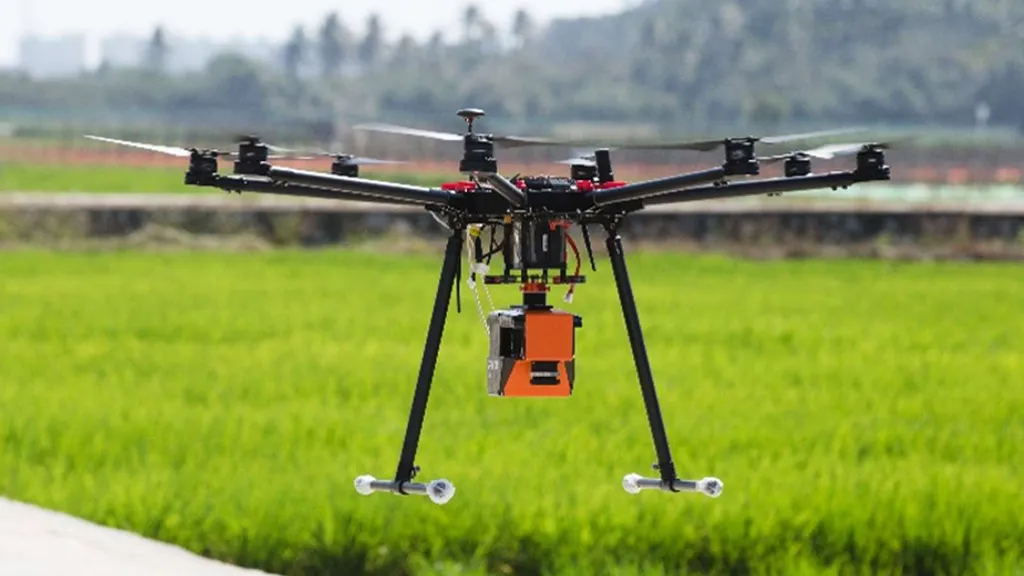
In the ever-evolving landscape of precision agriculture, a groundbreaking study published in *Frontiers in Plant Science* is set to revolutionize how farmers monitor and manage viral diseases in tobacco plants. The research, led by Chuntang Mao from the College of Big Data and Intelligent Engineering at Southwest Forestry University in China, introduces a novel approach to identifying Tomato Spotted Wilt Virus (TSWV) using unmanned aerial vehicles (UAVs) equipped with hyperspectral imaging technology.
TSWV is a significant threat to tobacco crops, causing substantial yield losses and quality degradation. Traditional detection methods, while effective at the leaf scale, fall short when applied to entire fields due to the complex canopy structures of crops. This complexity obscures the spectral characteristics of infected plants, making it challenging to identify TSWV-sensitive features. Mao and his team aimed to bridge this gap by developing a field-scale TSWV identification model using UAV-based hyperspectral imaging.
The study employed a UAV-mounted hyperspectral camera to capture detailed imagery of tobacco plants at the rosette stage. By comparing spectral data from healthy and infected plants, the researchers identified key spectral features associated with TSWV. They utilized a variety of feature extraction methodologies, including traditional statistical approaches like spectral ratio, correlation analysis, and principal component analysis (PCA), as well as machine learning techniques such as relevant features (Relief) and the successive projections algorithm. Additionally, they explored the use of vegetation indices to enhance their analysis.
The team then evaluated 18 classification models developed using three machine learning algorithms: support vector machine (SVM), k-nearest neighbors, and extreme gradient boosting. The results were impressive, with all integrated models combining Relief- and Correlation-selected feature bands delivering excellent performance. Notably, the SVM-Relief model achieved outstanding results, boasting an overall accuracy (OA) of 97.3%, an area under the curve (AUC) of 0.994, and a Kappa coefficient of 0.947.
Building on these findings, the researchers proposed a method called RPR, which integrates PCA with recursive feature elimination. This approach reduced the number of feature indicators from 15 to just 4 (775.6/772.9/781.1/756.4 nm). The resulting SVM-RPR combination model maintained performance levels comparable to the SVM-Relief model, demonstrating the significant value of red-edge bands in distinguishing healthy and TSWV-infected tobacco plants.
The implications of this research for the agriculture sector are profound. “Our study indicates the significant potential of integrating UAV-based hyperspectral imaging with machine learning techniques for rapid, non-destructive detection of tobacco TSWV at the field scale,” Mao explained. This approach offers a novel and efficient pathway for remote sensing-based monitoring of viral diseases in crops, with far-reaching implications for precision agriculture and plant disease management.
The ability to quickly and accurately identify TSWV infections can lead to more targeted and timely interventions, ultimately reducing yield losses and improving crop quality. This technology could also be adapted for use with other crops and diseases, paving the way for more sustainable and efficient agricultural practices.
As the agriculture industry continues to embrace technological advancements, the integration of UAVs and machine learning holds promise for transforming how farmers monitor and manage their crops. This research not only highlights the potential of these technologies but also sets the stage for future developments in the field of precision agriculture. With continued innovation and investment, the dream of smart, data-driven farming practices may soon become a reality, benefiting farmers and consumers alike.