
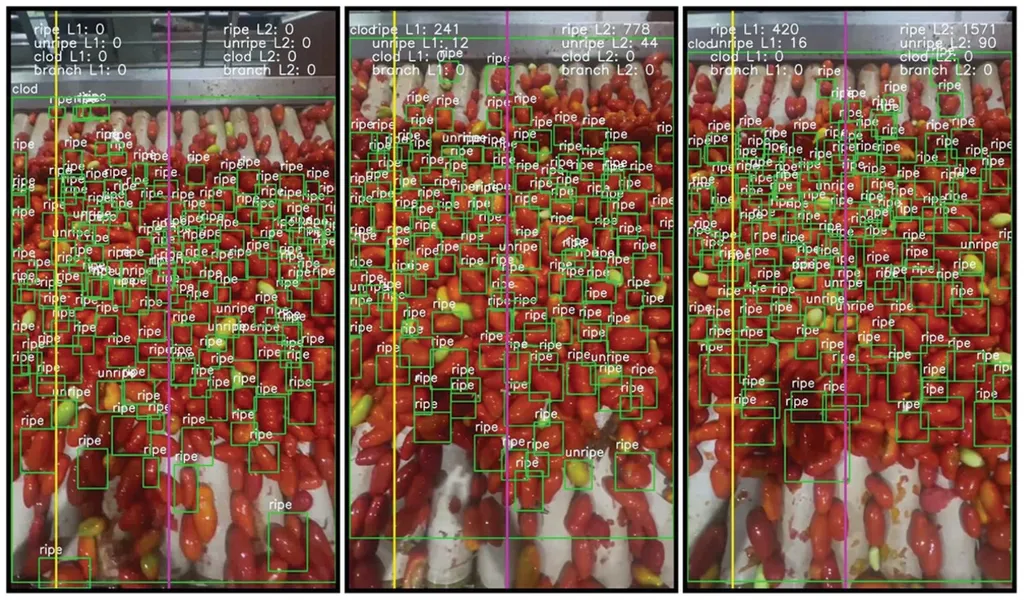
In the quest for precision agriculture, researchers have made significant strides in automating the process of yield estimation, particularly for tomato crops. A recent study published in *Information Processing in Agriculture* has evaluated state-of-the-art algorithms for detecting and tracking tomato clusters, offering promising insights for the agriculture sector.
The research, led by Zhongxian Qi from the College of Engineering at China Agricultural University, focuses on the critical task of automated vision-based detection and counting of tomato clusters. Accurate yield estimation is essential for precise yield management strategies and efficient food supply chains. However, challenges such as background clutter, occlusion, and varying sunlight can affect the accuracy of crop detection and counting.
To address these challenges, the study establishes a public multi-object tracking (MOT) dataset for tomato cluster counts and evaluates and compares state-of-the-art target detection and MOT-based algorithms. The evaluated detectors include YOLOv8 and RT-DETR, which balance accuracy and speed. The tracking algorithms assessed were SORT, DeepSort, ByteTrack, and BotSort.
The findings reveal that YOLOv8 and RT-DETR achieve impressive results, with RT-DETR exhibiting fewer false detections. When combined with the RT-DETR detector, the ByteTrack-based algorithm registers the highest counting accuracy at 95.5%, while BotSort achieves the highest MOTA score with 84.6%. Notably, trackers without the ReID module, such as SORT and ByteTrack, demonstrate greater adaptability to frame rate variations in the test videos.
“These algorithms have the potential to revolutionize the way we estimate crop yield,” says Zhongxian Qi. “By leveraging these technologies, we can move towards real-time, autonomous inspection platforms that significantly enhance the efficiency and accuracy of yield estimation.”
The commercial impacts of this research are substantial. Accurate yield estimation can lead to better resource management, reduced waste, and improved profitability for farmers. Additionally, the ability to track and count tomato clusters in real-time can streamline the supply chain, ensuring that produce reaches markets at the optimal time.
Looking ahead, the research team plans to integrate these algorithms into an autonomous inspection platform aimed at estimating crop yield in real-time. This development could pave the way for more sophisticated agricultural technologies, ultimately contributing to a more sustainable and efficient food supply chain.
As the agriculture sector continues to embrace technological advancements, the insights from this study offer a glimpse into the future of precision farming. By harnessing the power of automated detection and tracking, farmers and agribusinesses can achieve greater precision and efficiency, ultimately benefiting both the industry and consumers.