
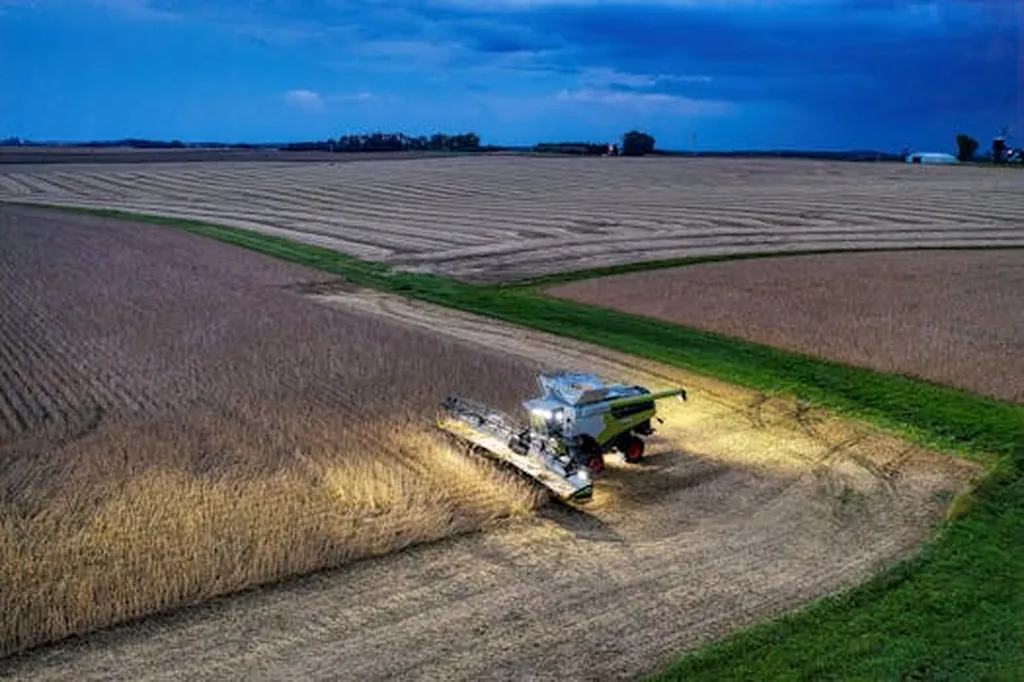
In the ever-evolving landscape of precision agriculture, a new tool has emerged that could significantly impact soybean farming. Researchers have developed DELTA-SoyStage, a lightweight yet powerful object detection architecture designed to monitor soybean growth stages with remarkable accuracy and efficiency. This innovation, published in the journal *Sensors*, could revolutionize how farmers optimize interventions and ultimately boost yields.
The accurate identification of soybean growth stages is crucial for timely agricultural interventions. Mistimed treatments can lead to yield losses ranging from 2.5% to 40%, a margin that can make or break a farming season. Existing deep learning approaches have been limited, often focusing on isolated developmental phases rather than providing comprehensive coverage. Enter DELTA-SoyStage, a novel architecture that combines an EfficientNet backbone with a lightweight ChannelMapper neck and a newly proposed DELTA (Denoising Enhanced Lightweight Task Alignment) detection head. This combination allows for precise soybean growth stage classification across nine critical stages, from emergence (VE) through full maturity (R8).
The dataset used to train DELTA-SoyStage is impressive in its scope, comprising 17,204 labeled RGB images collected under controlled greenhouse conditions. These images capture diverse imaging angles and lighting variations, ensuring the model’s robustness in real-world applications. Abdellah Lakhssassi, the lead author from the School of Computing at Southern Illinois University, emphasizes the importance of this comprehensive dataset: “The diversity in our dataset ensures that DELTA-SoyStage can perform reliably under various conditions, making it a versatile tool for farmers.”
DELTA-SoyStage achieves an average precision of 73.9% with only 24.4 GFLOPs computational cost. This is a significant improvement over existing models like DINO-Swin, which achieves 74.7% average precision but requires 102.5 GFLOPs. The new model demonstrates a 4.2× reduction in computational cost with only a 0.8% accuracy difference. The lightweight DELTA head and efficient ChannelMapper neck require only 8.3 M parameters, a 43.5% reduction compared to standard architectures, while maintaining competitive accuracy.
The computational efficiency of DELTA-SoyStage makes it ideal for deployment on resource-constrained edge devices. This means farmers can make timely decisions without relying on cloud infrastructure, a critical advantage in precision agriculture. “Our goal was to create a model that is not only accurate but also practical for real-world use,” says Lakhssassi. “By reducing the computational burden, we enable farmers to use this technology on-site, ensuring timely and effective interventions.”
The implications for the agriculture sector are profound. With DELTA-SoyStage, farmers can optimize their interventions, reducing yield losses and increasing overall productivity. The model’s efficiency and accuracy make it a valuable tool for crop monitoring, enabling farmers to make data-driven decisions that can significantly impact their bottom line.
Looking ahead, the success of DELTA-SoyStage could pave the way for similar models in other crops. The principles of lightweight, efficient, and accurate detection architectures can be applied to a wide range of agricultural applications, from monitoring wheat growth stages to detecting pests and diseases. This research, led by Abdellah Lakhssassi and published in *Sensors*, represents a significant step forward in the field of precision agriculture, offering a glimpse into a future where technology and farming intersect to create more sustainable and productive agricultural practices.