
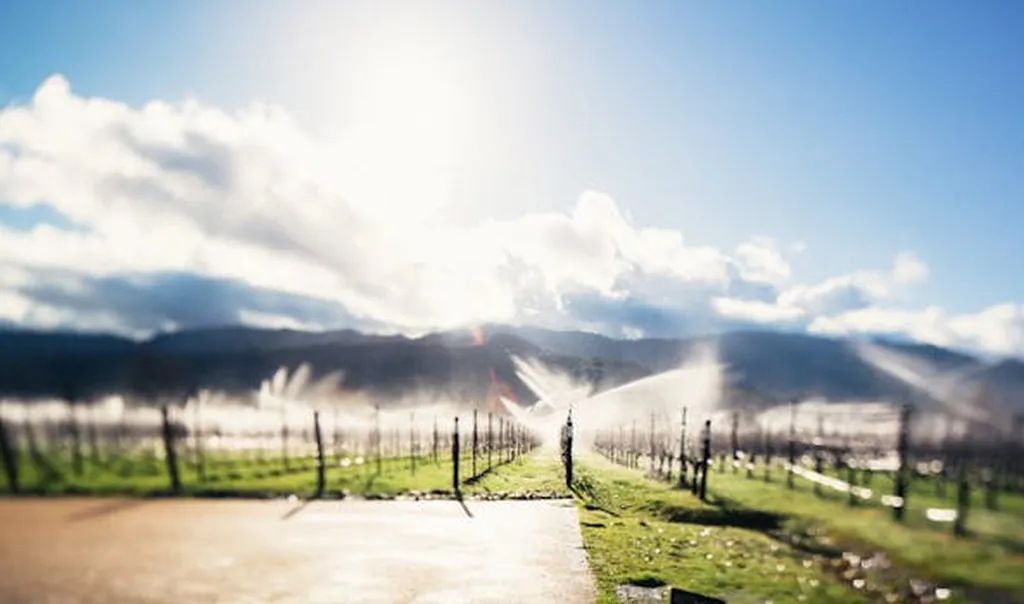
In the heart of Italy’s Trentino region, a quiet revolution is taking place in vineyard management, one that could reshape the future of agriculture. Researchers have been testing two innovative fuzzy-logic-based irrigation decision support systems, aiming to tackle the pressing challenge of water management in modern farming. The study, led by Romeo Silvestri from Fondazione Bruno Kessler in Trento, Italy, and published in the journal ‘Sensors’, offers a glimpse into the future of precision agriculture.
The two systems under scrutiny are a Mamdani-type controller, which relies on expert-defined rules, and a Takagi–Sugeno system that learns from ultra-local historical field data. Both integrate soil moisture sensing, short-term forecasting, and weather predictions to provide optimized irrigation recommendations. This is not just about saving water; it’s about using it more intelligently.
“Efficient water management is critical, especially with increasing climate variability and limited freshwater resources,” Silvestri explains. The study’s comparative field-based evaluation combines counterfactual simulations with a bootstrap-based statistical analysis to assess water use efficiency, soil moisture control, and robustness to environmental variability.
The findings reveal distinct strengths in both approaches, highlighting a trade-off between water conservation and crop stress mitigation. This is not just academic; it has real-world implications for the agriculture sector. With water scarcity becoming an increasingly pressing issue, the ability to optimize irrigation could significantly impact crop yields and farm profitability.
The Mamdani-type controller, with its reliance on expert rules, offers a more conservative approach to water use. It’s like having a seasoned farmer making decisions based on years of experience. On the other hand, the Takagi–Sugeno system, with its ability to learn from local data, provides a more adaptive and responsive approach. It’s like having a farmer who can learn and adapt to the unique conditions of each vineyard.
The study’s insights could pave the way for more intelligent irrigation management solutions. As climate change continues to impact weather patterns, the ability to adapt and respond to environmental variability will be crucial. The findings could also drive the development of more sophisticated IoT-based agriculture systems, further enhancing precision agriculture.
Moreover, the study’s focus on sustainable water management aligns with the growing global emphasis on environmental sustainability. As consumers increasingly demand sustainably produced goods, farms that can demonstrate efficient water use and environmental stewardship will have a competitive edge.
In the end, this research is not just about improving vineyard management in Trentino. It’s about shaping the future of agriculture, one drop of water at a time. As the agriculture sector grapples with the challenges of climate change and water scarcity, the insights from this study could prove invaluable. The journey towards more intelligent, sustainable, and efficient farming practices has just begun, and it’s a journey that will undoubtedly reshape the agriculture sector in the years to come.