
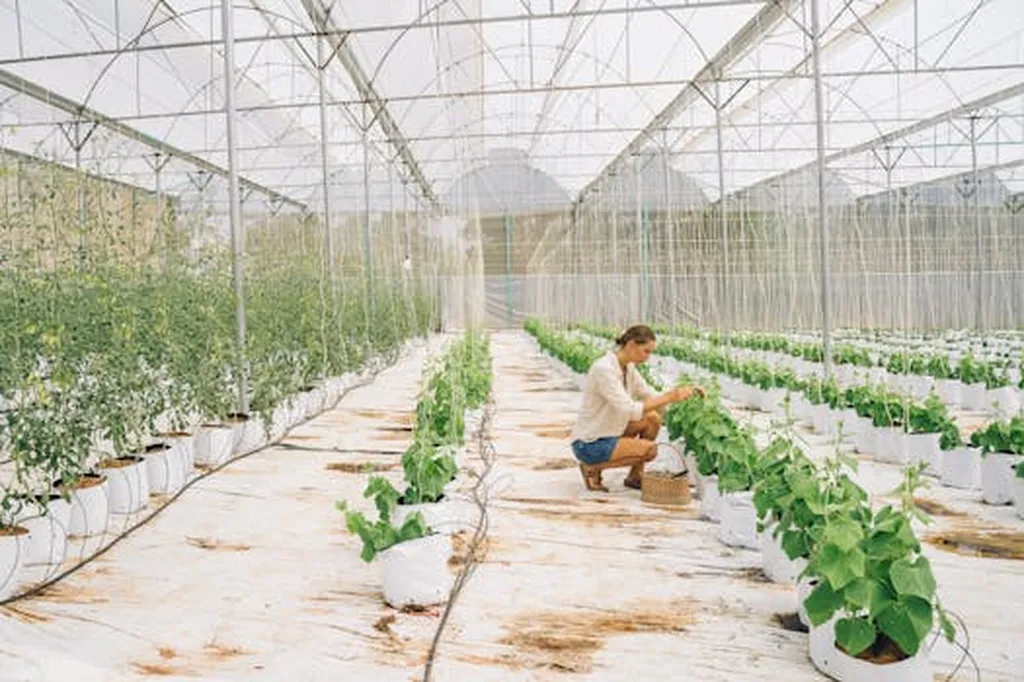
In the ever-evolving landscape of agricultural technology, a new breakthrough has emerged that could significantly streamline cucumber harvesting in greenhouses. Researchers have developed a lightweight, efficient model called LMS-Res-YOLO, designed to overcome the persistent challenges of background interference, target occlusion, and the computational constraints of edge devices. This innovation, published in the journal *Sensors*, holds promising implications for the agriculture sector, particularly in automated farming and precision agriculture.
The LMS-Res-YOLO model introduces three key advancements that set it apart from existing solutions. Firstly, it incorporates a plug-and-play HEU module, which enhances multi-scale feature representation while reducing computational redundancy. This means the model can process images more efficiently, identifying cucumbers even in complex environments. Secondly, the DE-HEAD component reduces the number of model parameters, floating-point operations (FLOPs), and overall model size, making it more suitable for deployment on resource-limited edge devices. Lastly, the integration of KernelWarehouse dynamic convolution (KWConv) strikes a balance between parameter efficiency and feature expression, ensuring robust performance.
The experimental results are impressive. The model achieves a mean Average Precision (mAP) of 97.9% at an intersection over union (IoU) threshold of 0.5, a 0.7% improvement over the benchmark model YOLOv8_n. It also achieves 87.8% mAP at IoU thresholds ranging from 0.5 to 0.95, a 2.3% improvement, and a 95.9% F1-score, a 0.7% improvement. Importantly, it reduces FLOPs by 33.3% and parameters by 19.3%, making it a more efficient and practical solution for real-world applications.
“Our model addresses the critical need for efficient cucumber detection in greenhouse environments,” said Bo Li, the lead author of the study from the Faculty of Applied Sciences at Macao Polytechnic University. “By enhancing feature representation and reducing computational overhead, we’ve created a tool that can significantly improve the accuracy and efficiency of automated harvesting systems.”
The commercial impacts of this research are substantial. In the agriculture sector, automated harvesting systems are becoming increasingly important as labor costs rise and the demand for precision agriculture grows. The LMS-Res-YOLO model can be integrated into these systems, enabling more accurate and efficient cucumber detection. This not only reduces the need for manual labor but also improves the overall yield and quality of the produce.
Moreover, the model’s efficiency makes it suitable for deployment on edge devices, which are often used in remote or resource-limited environments. This opens up new possibilities for small-scale farmers and those operating in challenging conditions, providing them with the tools they need to compete in the modern agricultural landscape.
The research also paves the way for future developments in the field of agricultural automation. As the technology continues to evolve, we can expect to see even more sophisticated models that can handle a wider range of crops and environmental conditions. This could lead to a significant shift in the way agriculture is practiced, moving towards a more automated, data-driven approach that maximizes efficiency and sustainability.
In conclusion, the LMS-Res-YOLO model represents a significant step forward in the field of agricultural technology. Its innovative design and impressive performance metrics make it a valuable tool for farmers and researchers alike. As the agriculture sector continues to embrace automation and precision agriculture, this research will undoubtedly play a crucial role in shaping the future of the industry.