
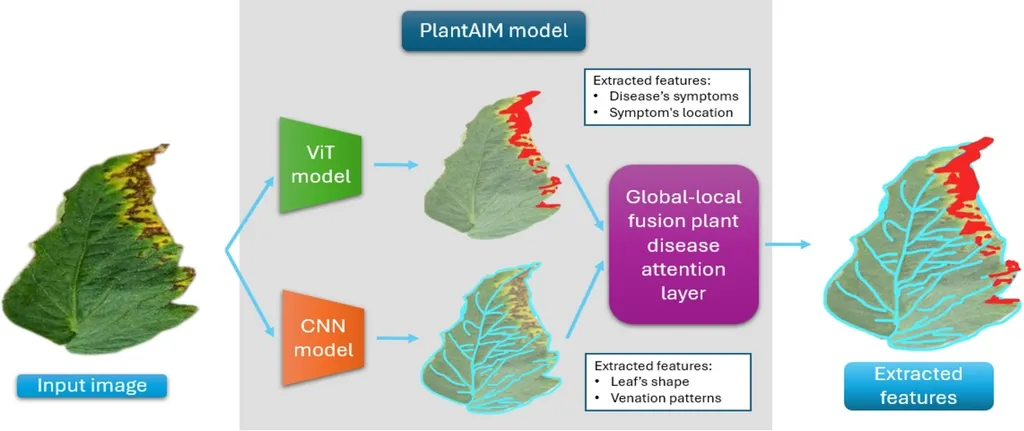
In the heart of Malaysia, researchers are harnessing the power of artificial intelligence to tackle a pressing global challenge: plant disease detection. Hong Zheng Marcus Lye, a lead author from Multimedia University in Cyberjaya, Selangor, has been at the forefront of this innovative work, published in the *JOIV: International Journal on Informatics Visualization*. His team is exploring how vision transformers, a cutting-edge type of deep learning model, can revolutionize the way farmers identify and treat plant diseases.
The stakes are high. Agriculture is under constant pressure to maximize yields while minimizing the use of chemicals. Over-reliance on pesticides and fungicides not only harms the environment but also contributes to the rise of resistant pathogens. Accurate and timely disease diagnosis is crucial for effective treatment and sustainable farming practices. “Automatic identification of plant diseases using computer vision techniques offers new and efficient approaches compared to traditional methods,” Lye explains. “Our goal is to develop a robust model that can analyze plant leaves comprehensively, focusing on the entire leaf rather than just individual parts.”
The team’s research focuses on enhancing the vision transformer model to better identify common plant diseases through leaf images. Traditional models often struggle with leaves that are not perfectly centered in the image or are oriented in unusual ways. To address this, the researchers introduced several innovative features, including Shift Patch Tokenization, Locality Self Attention, and Positional Encoding. These enhancements help the model focus on the whole leaf, improving its stability and accuracy.
The results are promising. The final test accuracy of the model is 89.58%, with relatively slight variances in precision, accuracy, and F1 score across different classes. The model also demonstrates robustness towards changes in leaf orientation and position within the image. “The model’s effectiveness shows the vision transformer’s potential for automated plant disease diagnosis,” Lye notes. “This can help farmers take timely measures to prevent losses and ensure food security.”
The commercial implications for the agriculture sector are significant. Automated disease detection can reduce the need for manual inspections, saving time and labor costs. It can also enable more precise and targeted use of pesticides, reducing overall chemical usage and environmental impact. Farmers can make data-driven decisions, applying treatments only when and where they are needed, ultimately leading to higher yields and more sustainable practices.
Looking ahead, this research could pave the way for broader applications of vision transformers in agriculture. As the technology matures, it may be integrated into drones or mobile apps, allowing farmers to quickly and easily diagnose plant diseases in the field. “The potential is immense,” Lye says. “We are just scratching the surface of what vision transformers can do for agriculture.”
In the quest for sustainable and high-yield agriculture, technology is proving to be a powerful ally. The work of Lye and his team at Multimedia University is a testament to the transformative power of AI, offering hope for a future where farmers can protect their crops more effectively and efficiently. As the agriculture sector continues to evolve, the integration of advanced technologies like vision transformers will undoubtedly play a crucial role in shaping its future.