
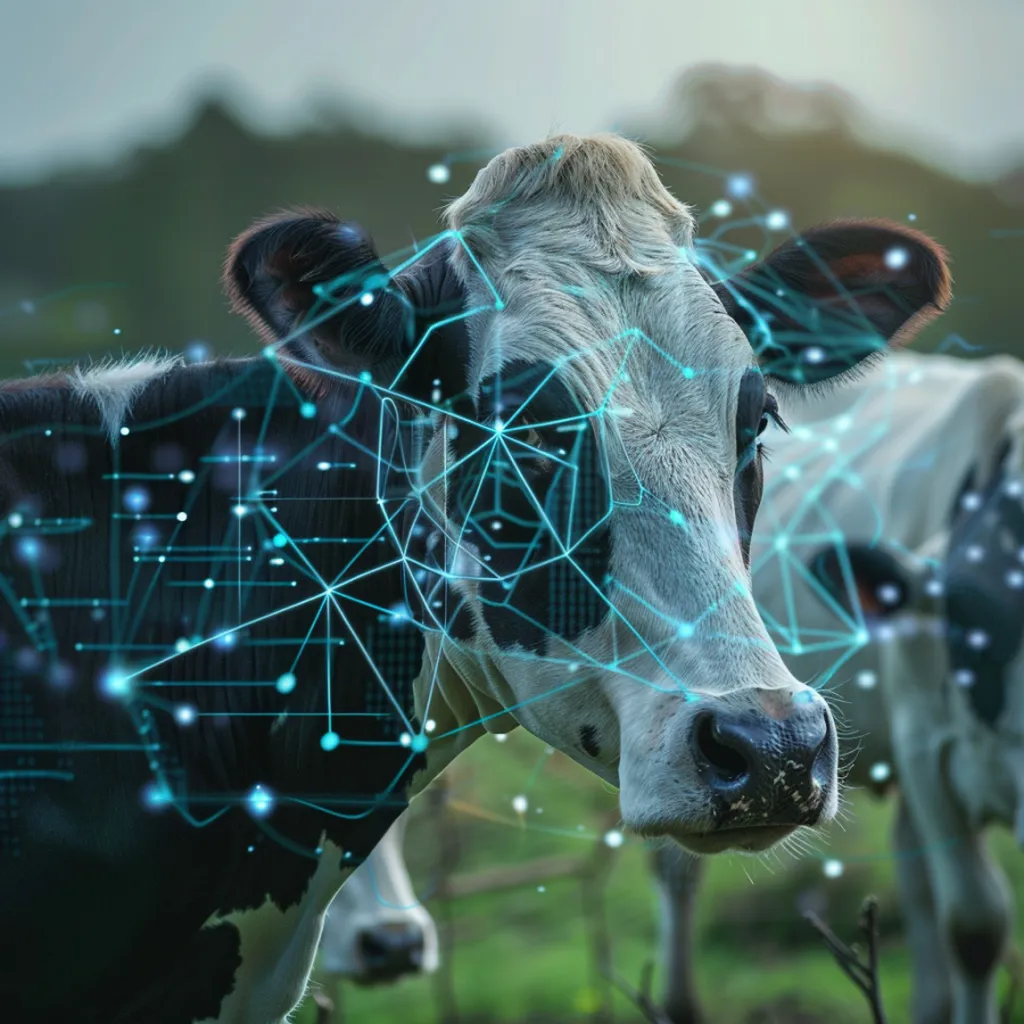
In the heart of Morocco, a groundbreaking study is transforming the way we understand and manage cattle behavior, with implications that ripple across the global agriculture sector. Researchers, led by Khalid El Moutaouakil from Sultan Moulay Slimane University, have harnessed the power of deep learning to decode the intricate movements of cattle, offering a glimpse into a future where technology and livestock management intertwine seamlessly.
The study, published in *Foods and Raw Materials*, equips cattle with wearable collars embedded with accelerometers. These devices, much like fitness trackers for humans, record the nuanced movements of the animals, providing a treasure trove of data. This data is then processed using deep learning algorithms, which classify behaviors such as feeding, moving, and lying with remarkable accuracy.
“Our goal was to create a system that could continuously monitor cattle behavior, providing farmers with real-time insights,” El Moutaouakil explained. “By understanding these behaviors, we can improve livestock welfare, detect health issues early, and ultimately enhance productivity.”
The implications for the agriculture sector are profound. Precision agriculture, a trend that has been gaining traction in recent years, could be revolutionized by this technology. Farmers could use these insights to optimize feeding schedules, improve living conditions, and even predict and prevent health issues. This proactive approach could lead to significant cost savings and improved animal welfare, a win-win for both farmers and their livestock.
Moreover, the study opens up new avenues for research in behavior classification and machine learning. The use of convolutional neural networks, a type of deep learning algorithm, has proven to be highly effective in this context. This success could inspire similar applications in other areas of agriculture, from poultry farming to aquaculture.
The research also underscores the importance of data in modern agriculture. As El Moutaouakil noted, “Data is the new soil. It’s the foundation upon which we can build smarter, more sustainable farming practices.” By leveraging data and advanced analytics, farmers can make informed decisions that enhance productivity and sustainability.
Looking ahead, this research could shape the future of livestock management. Imagine a world where farmers are alerted to potential health issues before they become critical, where feeding schedules are optimized based on real-time behavior data, and where livestock welfare is continuously monitored and improved. This is not just a pipe dream; it’s a future that is within our reach, thanks to studies like this one.
As the global population continues to grow, the demand for food will only increase. Studies like this one, which bridge the gap between technology and agriculture, will be crucial in meeting this demand sustainably and efficiently. The future of agriculture is not just about growing more food; it’s about growing it smarter. And with research like this, we’re well on our way.