
In the world of hydroponic farming, early detection of root mold in barley seedlings is a game-changer, and a team of researchers from the College of Engineering at Northeast Agricultural University in China has made significant strides in this area. Their work, published in *Information Processing in Agriculture*, introduces a novel, lightweight model called YOLOv8n-DDS, designed to enhance the accuracy and efficiency of root mold detection in barley seedlings.
Root mold proliferation is a persistent challenge in the industrial production of hydroponic barley seedlings. The early stages of root mold are particularly difficult to detect due to the small size and subtle coloration of the affected areas. Traditional detection methods often fall short, leading to potential crop losses and economic impacts. The YOLOv8n-DDS model addresses these issues by incorporating advanced techniques to improve detection accuracy and reduce computational load.
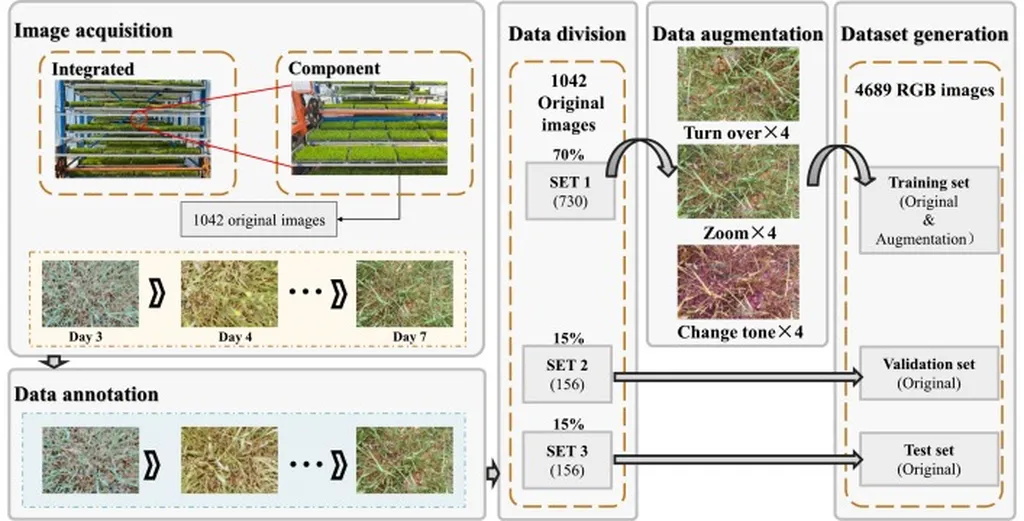
The researchers constructed a comprehensive dataset of root mold in barley seedlings throughout their growth cycle. This dataset was used to train and validate the YOLOv8n-DDS model, which integrates several innovative components. The dynamic sample (DySample) operator enhances the model’s ability to handle varying image sizes, while the combination of deformable ConvNets v2 (DCNv2) with C2f improves feature extraction. The detection head was reconstructed using seam carving (SEAM) technology, enabling the model to capture multi-scale, minute features of early-stage root mold.
To optimize the model for edge-embedded devices, the researchers employed layer-wise adaptive magnitude pruning and channel-wise knowledge distillation methods. These techniques significantly reduced the model’s parameter count and computational complexity, making it more suitable for deployment in resource-constrained environments. The pruned and distilled model was validated on the Jetson Nano platform, demonstrating impressive performance improvements.
“Our model outperformed the baseline model in terms of precision, recall, and mAP50 by 2.4%, 5.6%, and 2.2%, respectively,” said lead author Huang Junjie. “We also achieved a 23.8% reduction in parameter count and a 14.8% optimization in computational complexity. With TensorRT acceleration, the detection latency on embedded devices was further reduced by 25.8%.”
The commercial implications of this research are substantial. Early detection of root mold allows for timely intervention, reducing crop losses and improving the overall efficiency of hydroponic barley seedling production. The lightweight nature of the YOLOv8n-DDS model makes it particularly suitable for integration into existing agricultural systems, enhancing their intelligence and technological capabilities.
As the agriculture sector continues to embrace technological advancements, the YOLOv8n-DDS model represents a significant step forward in the intelligent and technological integration of industrial production processes. This research not only contributes to the immediate needs of hydroponic farming but also paves the way for future developments in agricultural technology.
The study, led by Huang Junjie from the College of Engineering at Northeast Agricultural University and the Northeast Key Laboratory of Smart Agricultural Technology, Ministry of Agriculture and Rural Affairs, highlights the potential of advanced detection models in transforming agricultural practices. As the sector continues to evolve, such innovations will play a crucial role in ensuring the sustainability and profitability of agricultural operations.