
In the heart of Pakistan’s agricultural landscape, a groundbreaking study is set to revolutionize wheat yield prediction, offering a promising tool for farmers and agribusinesses alike. By harnessing the power of machine learning algorithms and integrating remote sensing indices with climatic variables, researchers have unlocked new potential for accurate and timely crop yield forecasting.
The study, led by Muhammad Haseeb from the Institute of Space Science at the University of Punjab, Lahore, and published in *Information Processing in Agriculture*, meticulously examined ten model combinations within different wheat season scenarios. The research employed nonlinear models, such as Random Forest (RF) and Support Vector Machines (SVM), alongside linear models like Least Absolute Shrinkage and Selection Operator (LASSO) and Ridge regression.
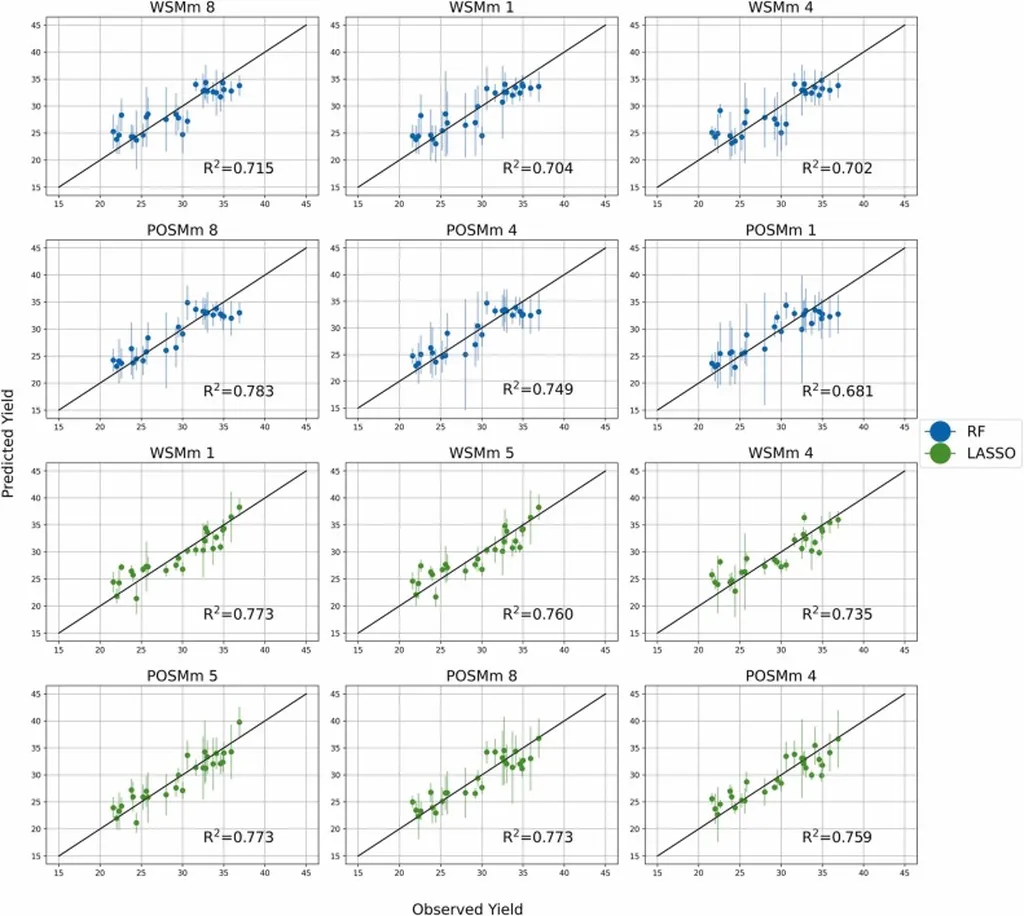
The findings are nothing short of transformative. In the Full Seasonal Mean Scenario 1 (FSM) (SC1), the RF model combination (GNDVI + SPEI + WS + SM) outperformed other models, achieving an impressive R² of 0.75. Similarly, in the Peak Seasonal Mean Scenario 2 (PSM) (SC2), the RF regression model combination (GNDVI + SPEI + WS + SM) demonstrated the highest performance, with an R² of 0.78. These results underscore the potential of machine learning methodologies in providing accurate and timely crop yield predictions.
“The integration of remote sensing indices and climatic variables through advanced machine learning algorithms offers a robust foundation for ensuring regional food security,” Haseeb explained. “Our findings advocate for utilizing the Peak Seasonal Mean Scenario 2 (SC2) for yield prediction in ML models, which can significantly enhance decision-making processes for farmers and agribusinesses.”
The commercial impacts of this research are profound. Accurate yield predictions enable farmers to optimize resource allocation, reduce waste, and maximize profits. Agribusinesses can leverage this information to streamline supply chains, improve market forecasting, and enhance overall operational efficiency. Moreover, the study’s emphasis on various crop growth stages ensures that the benefits extend across the entire agricultural value chain.
Looking ahead, this research paves the way for future developments in the field. As machine learning algorithms continue to evolve, their integration with remote sensing and climatic data holds the promise of even more precise and reliable yield predictions. This, in turn, can contribute to global efforts in ensuring food security and sustainability.
In the words of Haseeb, “The potential of machine learning in agriculture is vast and largely untapped. Our study is just the beginning, and we are excited about the possibilities that lie ahead.”
As the agricultural sector continues to embrace technological advancements, the insights gleaned from this research will undoubtedly play a pivotal role in shaping the future of farming and agribusiness.