
In the vast, sun-scorched expanses of semi-arid rangelands, a delicate dance between livestock and ecosystem unfolds. This dance, however, is increasingly threatened by droughts and overgrazing, putting the livelihoods of millions, particularly in the Global South, at risk. A recent study published in *Ecological Indicators* offers a promising new approach to monitor and manage these critical ecosystems, with significant implications for the agriculture sector.
The research, led by Lisa-Maricia Schwarz from the University of Bonn, introduces composite grazing pressure indices that could revolutionize how we predict and manage rangeland dynamics. Traditional methods often rely on a single metric, such as distance from water sources, but Schwarz and her team have shown that a more nuanced approach can yield better results.
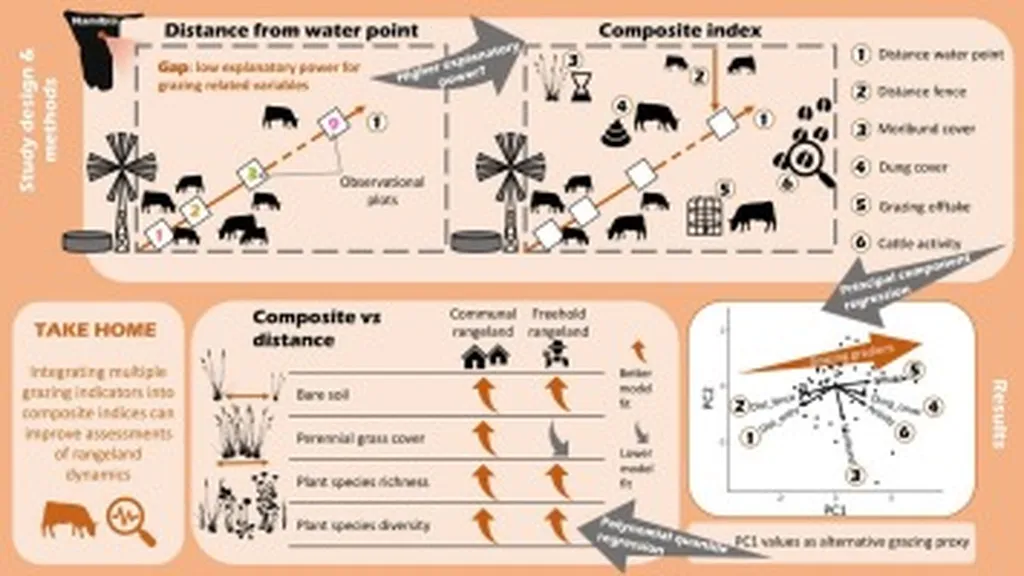
“We found that composite grazing indices offer greater explanatory power than the widely used indicator ‘distance from water source’,” Schwarz explained. The team developed three indices of increasing complexity, incorporating variables like distance measures, grazing offtake, moribund plant material, and signs of cattle activity. These indices reflect both long- and short-term grazing pressure, providing a more comprehensive picture of rangeland health.
The study evaluated these indices using data from communal and freehold rangelands in Namibia. By fitting quantile regression models with response variables like bare soil, perennial grass cover, plant species richness, and plant species diversity, the researchers found notable improvements in model fit with increasing model complexity. This was particularly evident for plant species diversity, which displayed a unimodal relationship with grazing pressure but none with distance from water.
The implications for the agriculture sector are substantial. Accurate prediction of rangeland dynamics can inform better livestock management practices, ensuring sustainable use of these vital ecosystems. “Despite high data variability and generally low model fit, our results demonstrate that composite grazing pressure indices offer great potential to capture and compare semi-arid rangeland dynamics at finer spatial resolution than a single distance-based metric,” Schwarz noted.
This research could shape future developments in ecosystem services, environmental monitoring, and livestock management. By adopting these composite indices, farmers and land managers can make more informed decisions, balancing the needs of livestock with the health of the rangelands. As the impacts of climate change continue to intensify, such tools will be crucial in safeguarding the livelihoods of those who depend on these fragile ecosystems.
The study, published in *Ecological Indicators*, was led by Lisa-Maricia Schwarz from the Institute of Crop Science and Resource Conservation at the University of Bonn. The research highlights the potential of composite grazing pressure indices to improve the prediction of semi-arid rangeland dynamics, offering a valuable tool for the agriculture sector in the face of growing environmental challenges.