
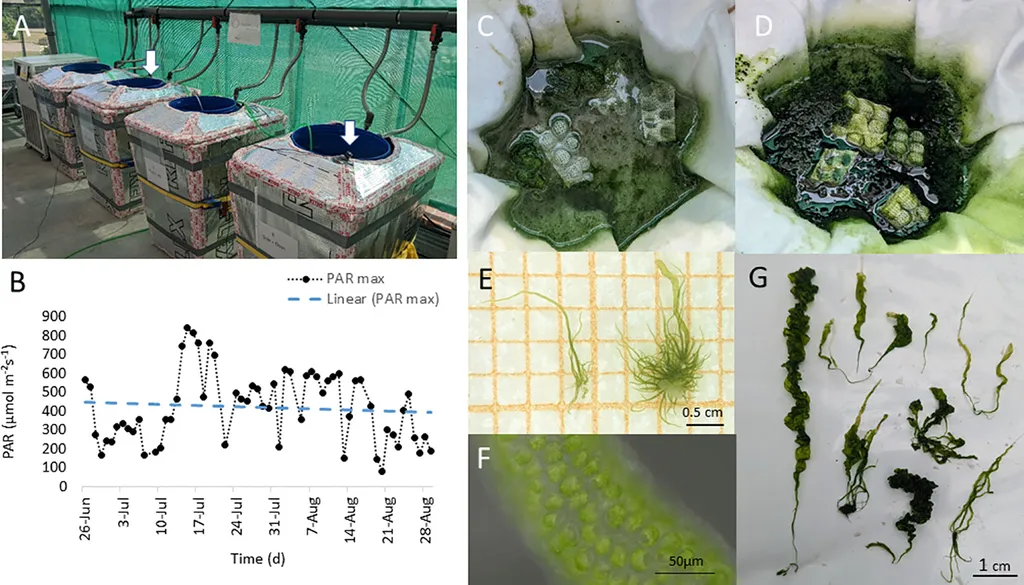
In the quest for sustainable agriculture, researchers have turned to an unlikely ally: seaweed. A recent study published in the *Annals of Agricultural Sciences* explores the potential of Ulva prolifera, a macroalga notorious for causing green tides, as a bio-fermentation extract to boost crop growth and soil health. The findings could open new avenues for agritech innovation and circular economy practices in agriculture.
The study, led by Wen Liu from the Jiangsu Key Laboratory of Marine Bioresources and Environment at Jiangsu Ocean University, investigated the effects of Ulva prolifera-derived bio-fermentation (UF) extract on cherry radish (Raphanus sativus var. radicula). The research revealed that low-concentration UF extracts significantly enhanced root development and nutritional quality. Specifically, a 10% concentration yielded the highest root weight, anthocyanin, soluble protein, soluble carbohydrate, and leaf pigment contents. “The 10% concentration stood out as the optimal level for promoting cherry radish growth and nutritional quality,” Liu noted.
The implications for the agriculture sector are substantial. As the demand for sustainable and high-quality produce grows, farmers are increasingly seeking eco-friendly alternatives to traditional fertilizers. Ulva prolifera, often considered a nuisance due to its tendency to form massive blooms, could be repurposed into a valuable agricultural input. This aligns with circular economy principles, where waste is transformed into resources, reducing environmental impact and costs.
However, the study also found that higher concentrations of UF extract (20%–30%) diminished these growth-promoting effects, although they increased root vitamin C content, soil nitrogen, phosphorus, and potassium levels, and induced soil acidification. This dual functionality suggests that UF extract could serve as both a plant growth promoter and a soil conditioner, offering farmers a versatile tool to enhance crop yield and soil health.
The research highlights the potential of seaweed-derived extracts in sustainable agriculture. As Wen Liu explained, “Our findings indicate that Ulva prolifera bio-fermentation extract can be a dual-functional plant growth promoter and soil conditioner.” This could pave the way for future developments in agritech, where seaweed extracts are integrated into farming practices to improve crop productivity and environmental sustainability.
In conclusion, the study published in the *Annals of Agricultural Sciences* offers promising insights into the use of Ulva prolifera-derived bio-fermentation extract for enhancing cherry radish growth and soil fertility. The findings could shape future developments in the field, providing farmers with innovative and sustainable solutions to meet the growing demand for high-quality produce. As the agriculture sector continues to evolve, the integration of seaweed-derived extracts could play a pivotal role in achieving sustainable and productive farming practices.