
In the verdant landscapes of the Nilgiris district in Tamil Nadu, a silent revolution is brewing, one that could redefine the future of agriculture and climate change mitigation. A recent systematic review, published in *Frontiers in Forests and Global Change*, has shed light on the immense potential of agroforestry systems to sequester carbon while boosting the livelihoods of local communities. The research, led by Palanivelan Jaisridhar from ICAR – Krishi Vigyan Kendra, Tamil Nadu Agricultural University, offers a beacon of hope for sustainable agriculture and climate action.
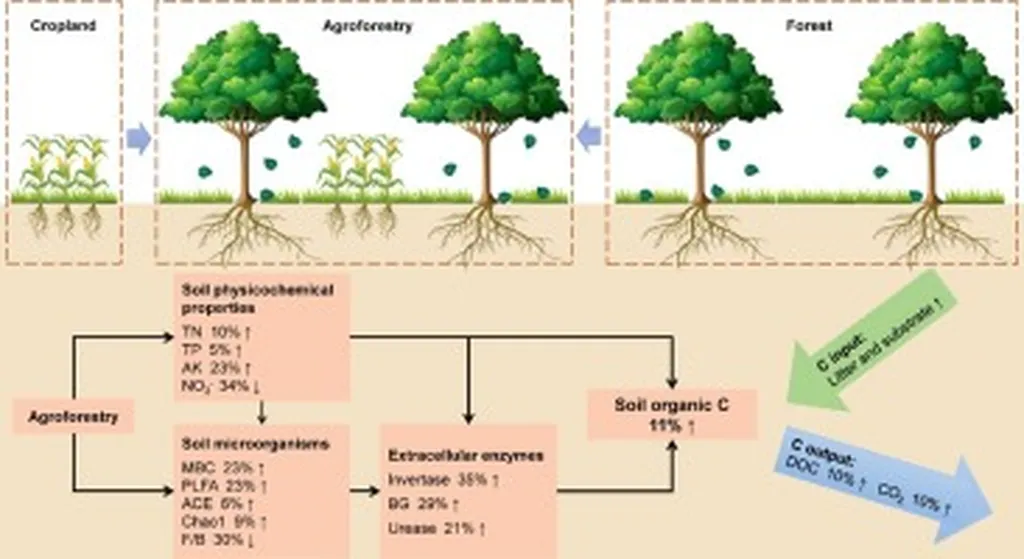
The study, which analyzed 80 articles from the Web of Science and Scopus databases, reveals that agroforestry systems in the Nilgiris can sequester carbon at rates ranging from 0.25 to 19.14 Mg C/ha/year in tree components and 0.01 to 0.60 Mg C/ha/year in crop components. This variability is influenced by factors such as system design, species composition, and management practices. Notably, agro-horticulture systems emerged as the most promising, with a carbon sequestration potential of 38.11 Mg C/ha, a staggering 31.64% higher than conventional agriculture.
The economic implications of these findings are profound. The research indicates that agroforestry systems can be approximately four times more profitable than monoculture systems, even without factoring in carbon revenues. When carbon pricing is considered, the profitability of agroforestry systems is further enhanced, presenting a compelling case for farmers to adopt these practices.
“Agroforestry systems not only offer environmental benefits but also provide economic incentives for farmers,” said lead author Palanivelan Jaisridhar. “This dual advantage makes them a powerful tool for climate change mitigation and sustainable livelihoods.”
The study proposes a methodological framework for carbon trading in the Nilgiris, addressing key challenges such as high transaction costs, methodological complexities, and equitable benefit-sharing. This framework aims to link carbon storage with income generation opportunities, thereby promoting environmental conservation and community welfare.
The research also highlights the need for affordable monitoring systems in resource-poor areas, ensuring that the benefits of carbon trading are accessible to all. By combining environmental conservation goals with economic incentives, this study paves the way for a more sustainable and equitable future.
As the world grapples with the urgent need for climate change mitigation, the findings of this systematic review offer a glimmer of hope. By embracing agroforestry systems, the agriculture sector can play a pivotal role in sequestering carbon while enhancing the livelihoods of farmers. The proposed framework for carbon trading in the Nilgiris could serve as a model for other regions, fostering a global movement towards sustainable agriculture and climate action.
In the words of Palanivelan Jaisridhar, “The future of agriculture lies in our ability to balance environmental stewardship with economic prosperity. Agroforestry systems offer a promising path forward, one that benefits both the planet and its people.”