
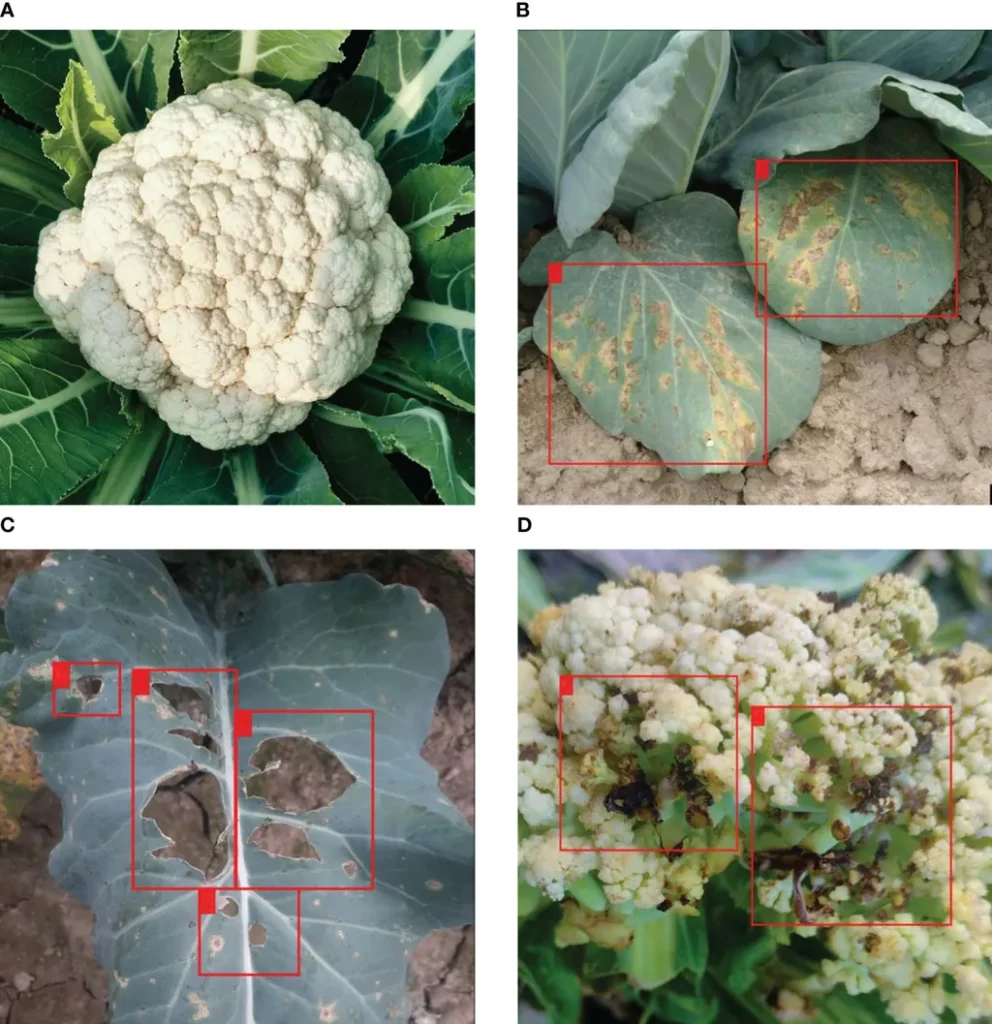
In the ever-evolving landscape of precision agriculture, a groundbreaking study published in *Array* is set to revolutionize how farmers and agritech companies approach disease management in cauliflower crops. The research, led by MD. Zahin Muntaqim from the Department of Computer Science and Engineering at Bangladesh Army University of Science and Technology (BAUST), introduces a novel framework that combines Federated Learning (FL) and Few-Shot Learning (FSL) to classify cauliflower leaf diseases with remarkable accuracy, even when data distributions are non-identical across different regions and farms.
Traditional machine learning models often struggle with limited and diverse datasets, a common challenge in agriculture due to varying environmental conditions and farming practices. Muntaqim’s study addresses this by leveraging the strengths of both FL and FSL. Federated Learning allows multiple clients (or farms) to collaboratively train a model without sharing their raw data, preserving privacy and security. Few-Shot Learning, on the other hand, enables the model to adapt to new disease classes with just a few samples, making it highly efficient in real-world scenarios where data is scarce.
“The beauty of our hybrid framework lies in its ability to generalize across tasks without requiring large, labeled datasets,” Muntaqim explains. “This makes it particularly useful for farmers who may not have access to extensive data but still need accurate and timely disease detection to protect their crops.”
The study utilized five clients, each training on a small set of labeled data and evaluating the model on unseen data. The Reptile meta-learning algorithm was employed to implement Few-Shot Learning, allowing each client to quickly adapt to new classes with minimal samples. To further enhance prediction accuracy, the researchers implemented an ensemble voting mechanism, combining predictions from multiple pre-trained deep learning models, including VGG16, ResNet50V2, Xception, DenseNet169, and MobileNetV2. This ensemble approach aggregates individual model predictions, selecting the most common class prediction to improve overall classification performance.
The results are impressive: the ensemble model achieved a test accuracy of 95% for 2-shot configurations, 97% for 3-shot and 4-shot, and a perfect 100% for 5-shot configurations. These findings highlight the effectiveness of the hybrid framework in providing accurate disease classification even in heterogeneous environments.
The commercial implications for the agriculture sector are significant. Farmers can now benefit from a scalable and adaptable solution that requires minimal data and offers high accuracy in disease detection. This can lead to optimized yield, reduced crop loss, and improved disease management strategies. Agritech companies can also leverage this framework to develop more robust and efficient disease detection tools, enhancing their product offerings and market competitiveness.
As the agriculture industry continues to embrace smart farming technologies, this research paves the way for more innovative and data-driven approaches to crop management. By combining the strengths of Federated Learning and Few-Shot Learning, Muntaqim’s study offers a promising solution to the challenges of data diversity and scarcity, ultimately contributing to more sustainable and productive farming practices.
The study, published in *Array* and led by MD. Zahin Muntaqim from the Department of Computer Science and Engineering at Bangladesh Army University of Science and Technology (BAUST), marks a significant step forward in the field of precision agriculture, offering a scalable and adaptable solution for disease detection and management.