
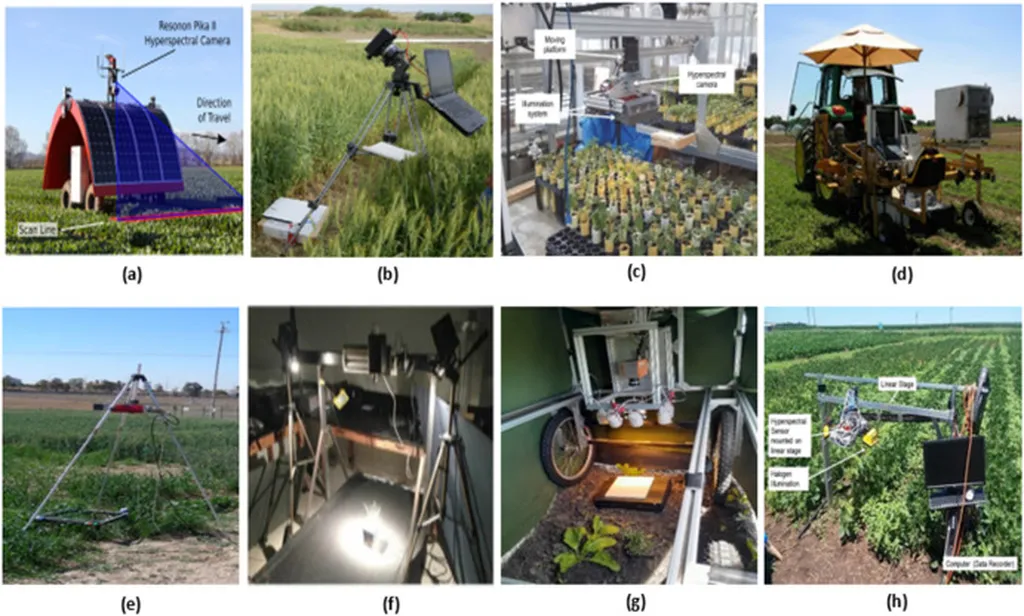
In the heart of China’s cold northern regions, a groundbreaking study is reshaping how we perceive and manage agricultural biodiversity. Researchers, led by Zhentao Wang from the College of Mechanical and Electrical Engineering at Shihezi University, have harnessed the power of hyperspectral imaging and deep learning to distinguish between rice and weed species with unprecedented accuracy. Their findings, published in *Frontiers in Plant Science*, could revolutionize weed management strategies and boost crop yields globally.
Weeds, while contributing to ecosystem services, pose a significant challenge to global crop production. Traditional methods of weed identification and management are often labor-intensive and time-consuming. Enter hyperspectral imaging, a technology that has evolved from mere spectral response patterns to sophisticated species identification and vegetation monitoring. Wang and his team have taken this technology to new heights, establishing a hyperspectral library of rice and weed species and developing a deep learning network to identify them with remarkable precision.
The study collected 1080 hyperspectral images of 36 species, including rice and 35 weeds, using a ground-based hyperspectral camera. The team then extracted representative spectral reflectance curves and employed various analytical techniques to characterize and explain the differences among the species. “The spectral profiles of these plants are like fingerprints,” Wang explains. “Each species has a unique spectral signature that allows us to identify and monitor them accurately.”
The researchers developed a novel deep learning network called SS-CNN to identify rice and weed species from the hyperspectral imagery. Ablation experiments were conducted to evaluate its performance, and the results were impressive. With a training sample size of 70%, the SS-CNN model achieved an overall accuracy of 99.910%, an average accuracy of 99.502%, and a Kappa coefficient of 0.9991. Even with a reduced training sample size of just 5%, the model maintained optimal classification performance, with an overall accuracy of 95.370%.
The implications of this research for the agriculture sector are profound. Accurate and efficient weed identification can lead to targeted herbicide application, reducing chemical use and environmental impact. It can also enable precision agriculture, where resources are allocated based on the specific needs of the crop and the prevailing weed species. “This technology can help farmers make data-driven decisions,” Wang says. “It’s not just about identifying weeds; it’s about understanding their growth patterns and physiological activity to manage them effectively.”
The study provides a valuable baseline for understanding the hyperspectral characteristics of paddy field weed stress and monitoring their growth status. It opens up new avenues for research and development in the field of agricultural remote sensing. Future developments could include the integration of hyperspectral imaging with other technologies, such as drones and satellites, for large-scale weed monitoring and management.
In the quest for sustainable and efficient agriculture, this research is a significant step forward. It demonstrates the potential of hyperspectral imaging and deep learning to transform weed management strategies and boost crop yields. As we grapple with the challenges of feeding a growing global population, such innovations are not just welcome; they are essential.