
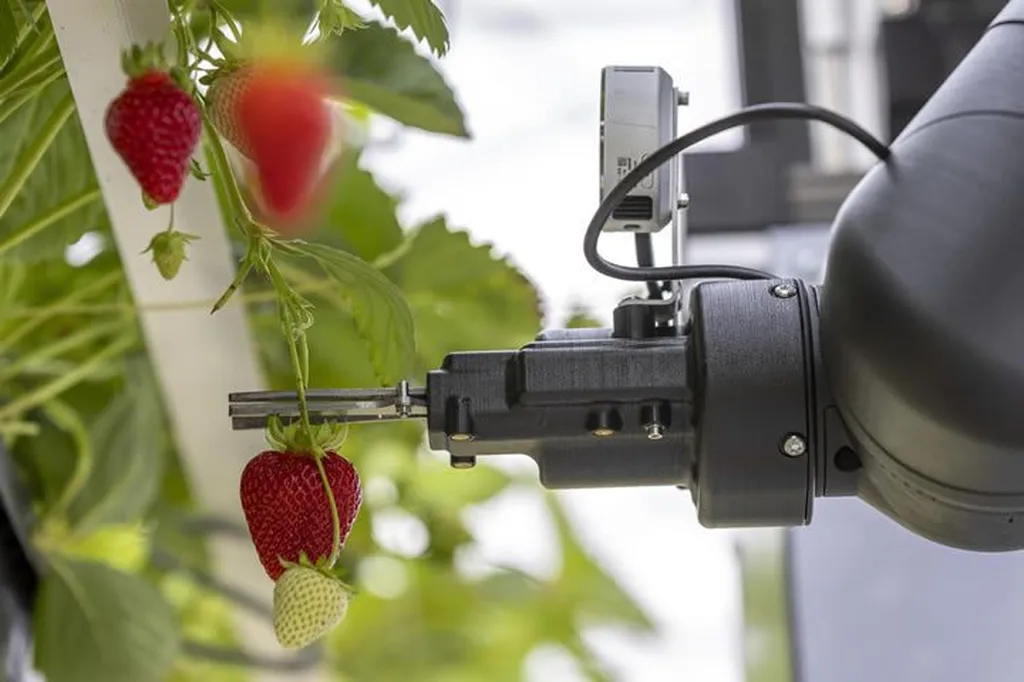
In the heart of China’s agricultural landscape, a technological revolution is brewing, promising to transform the way strawberries are sorted and handled. Researchers, led by Liwei Wang from the Institutions of Electrical and Information at Northeast Agricultural University, have developed an intelligent strawberry sorting robot that could redefine efficiency and precision in the agriculture sector.
The robot, detailed in a recent study published in ‘Smart Agricultural Technology’, integrates advanced machine vision technology with a Delta parallel arm and a flexible robotic gripper. This innovative system is designed to tackle a persistent challenge in the strawberry industry: the delicate nature of the fruit, which makes it susceptible to mechanical damage during sorting.
“Our goal was to create a system that could mimic the delicate touch and keen eye of a human sorter, but with the speed and consistency of a machine,” Wang explained. The robot achieves this by utilizing visual recognition technology to plan the sorting path, identify ripe strawberries, and analyze their ripeness.
The results are impressive. The sorting robot achieves an accuracy rate of 96.4–96.7% and an average sorting time of approximately 0.71 seconds per strawberry. This level of precision and efficiency could significantly reduce labor costs in strawberry production, a boon for an industry that has long relied on manual labor for sorting.
The commercial impacts of this technology are substantial. Strawberry farms could see increased productivity and reduced waste, as the robot’s gentle handling minimizes damage to the fruit. Moreover, the consistent quality control provided by the robot could enhance the marketability of the strawberries, benefiting both farmers and consumers.
Beyond strawberries, the technology has the potential to be adapted for other soft fruits and even vegetables, opening up new avenues for automation in the agriculture sector. “This is just the beginning,” Wang noted. “The principles behind this technology can be applied to a wide range of produce, making our farms smarter and more efficient.”
The development of this intelligent sorting robot is a testament to the power of integrating advanced technologies into traditional industries. As the agriculture sector continues to evolve, such innovations will play a crucial role in shaping its future. The research led by Wang, affiliated with the Key Laboratory of Northeast Smart Agricultural Technology, Ministry of Agriculture and Rural Affairs, Heilongjiang Province, Harbin, is a significant step forward in this exciting journey.