
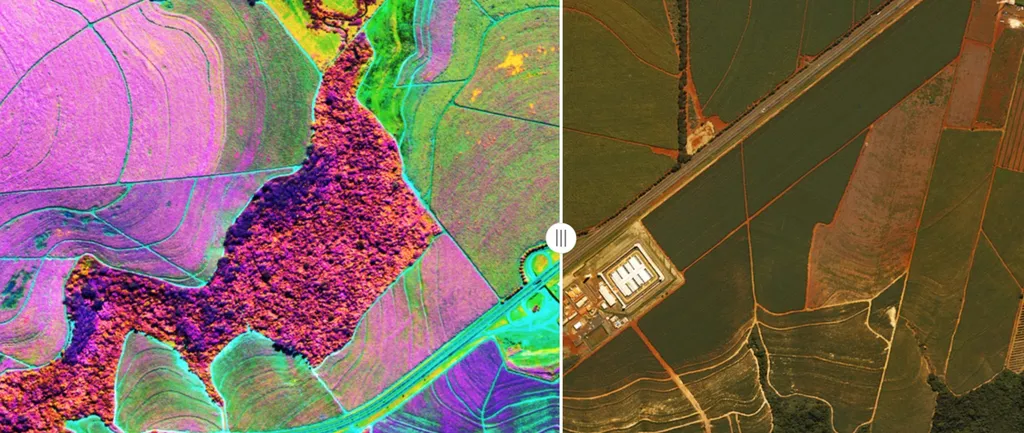
In the vast landscape of agricultural technology, a new breakthrough is making waves, promising to revolutionize how we interpret and utilize hyperspectral imaging (HSI) data. Researchers have developed a novel method to visualize high-dimensional hyperspectral data, enhancing image contrast, structural detail, and informativeness—critical factors for precision agriculture and remote sensing applications.
Hyperspectral imaging captures data across hundreds of contiguous spectral bands, providing a wealth of information about crop health, soil conditions, and other agricultural metrics. However, the sheer volume of data makes visualization challenging. Traditional methods map the first three reduced dimensions to the red, green, and blue channels for RGB visualization. While effective, these methods often fall short in capturing the full richness of the data.
Enter HSBDR-H, a groundbreaking approach developed by Vahe Atoyan and colleagues at UiT The Arctic University of Norway. This method defines pixel colors by mapping the two reduced dimensions to hue and saturation gradients and then calculating per-pixel brightness based on band entropy. “Pixels with high intensities in informative bands appear brighter,” explains Atoyan, highlighting the method’s ability to highlight key features in the data.
The beauty of HSBDR-H lies in its versatility. It can be applied on top of any dimension reduction (DR) technique, improving image visualization while preserving low computational cost and ease of implementation. This adaptability makes it a powerful tool for agricultural applications, where quick and accurate data interpretation is crucial.
In tests across various datasets, HSBDR-H consistently outperformed standard RGB mappings. The method’s superior performance was particularly evident in highly detailed urban datasets, but its potential extends far beyond urban planning. For the agriculture sector, this means more accurate and detailed insights into crop health, soil conditions, and other critical factors.
The implications for precision agriculture are profound. Farmers and agronomists can make more informed decisions, optimizing resource use and improving yields. “This method can enhance the interpretation of complex hyperspectral data, making it more accessible and actionable,” says Atoyan, underscoring the practical benefits of the research.
The study, published in *Frontiers in Remote Sensing*, represents a significant step forward in the field of hyperspectral imaging. As the agriculture sector continues to embrace technology, tools like HSBDR-H will play a pivotal role in shaping the future of farming. By providing clearer, more detailed visualizations of hyperspectral data, this method opens up new possibilities for innovation and efficiency in agriculture.
Looking ahead, the potential applications of HSBDR-H extend beyond agriculture. Any field requiring high-dimensional data visualization could benefit from this method, from environmental monitoring to medical imaging. As researchers continue to explore and refine this approach, the possibilities are endless.
In the ever-evolving landscape of agritech, HSBDR-H stands out as a beacon of innovation, promising to transform how we see and understand the world around us. With its ability to enhance image contrast, structural detail, and informativeness, this method is set to become a cornerstone of modern agricultural practices, driving progress and sustainability in the years to come.