
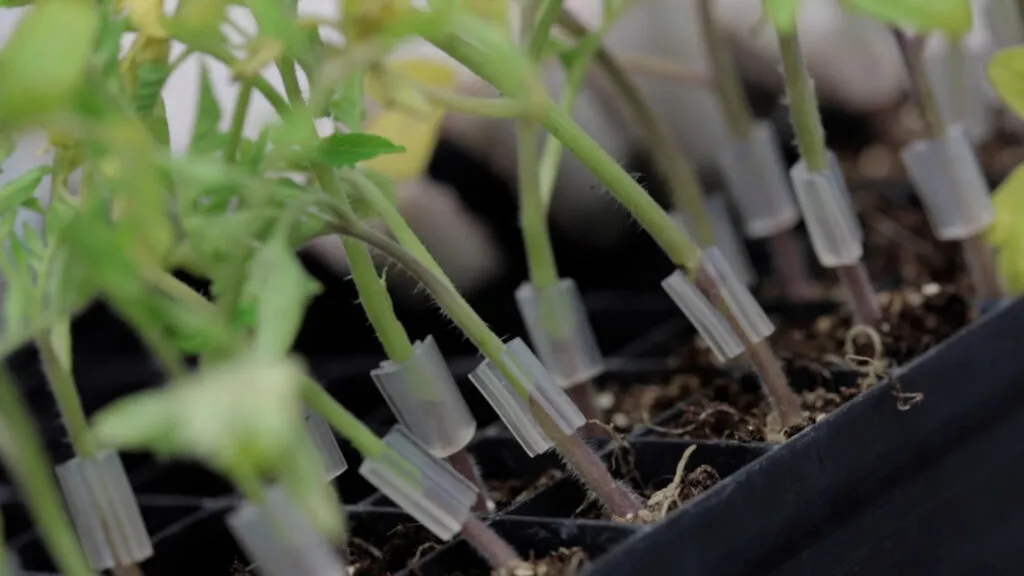
In the heart of modern agriculture, where technology and tradition intersect, a groundbreaking study has emerged, promising to revolutionize the way we cultivate and graft tomato seedlings. Published in *Frontiers in Plant Science*, the research led by Yichi Wang introduces an intelligent control method for seedling growth, leveraging machine learning to optimize the grafting process.
The study addresses a critical challenge in greenhouse cultivation: the non-uniform and unstable lighting conditions that make it difficult to implement targeted control over seedlings. “The variability in lighting conditions can lead to inconsistencies in seedling growth, which in turn affects the quality of automatic grafting,” explains Wang. To overcome this, the researchers turned to plant factories, where environmental factors like light can be precisely adjusted to create optimal growing conditions.
The team established an evaluation method for tomato seedlings suitable for automatic grafting and scored seedlings that underwent light recipe transitions at different time points. By combining this comprehensive weighting with growth data under various light environments, they employed six machine learning algorithms to establish growth prediction models. The results were impressive, with XGBoost achieving the highest accuracy for predicting rootstock and scion growth, boasting R2 values of 0.9253 and 0.9334, respectively.
The practical implications of this research are substantial. A smart light control system was developed and tested, revealing that the automatic grafting success rate and post-grafting survival rate of light-regulated seedlings were 8.3% and 1.4% higher than those of commercially available seedlings. “This demonstrates the feasibility of the model and highlights the practical application of the system in precision agriculture,” says Wang.
The potential commercial impacts for the agriculture sector are profound. By optimizing seedling growth and improving grafting success rates, farmers can enhance crop yields and reduce waste. This technology could also lead to more efficient use of resources, as precise control over environmental factors can minimize energy consumption and maximize productivity.
Looking ahead, this research opens up exciting possibilities for future developments in the field. The integration of machine learning and smart control systems could extend beyond tomato seedlings to other crops, paving the way for more sophisticated and efficient agricultural practices. As the agriculture sector continues to embrace technology, studies like this one will play a crucial role in shaping the future of farming.
While the lead author’s affiliation remains unknown, the significance of this work is undeniable. By bridging the gap between technology and agriculture, this research offers a glimpse into a future where precision and innovation drive the growth of our crops and the success of our farms.