
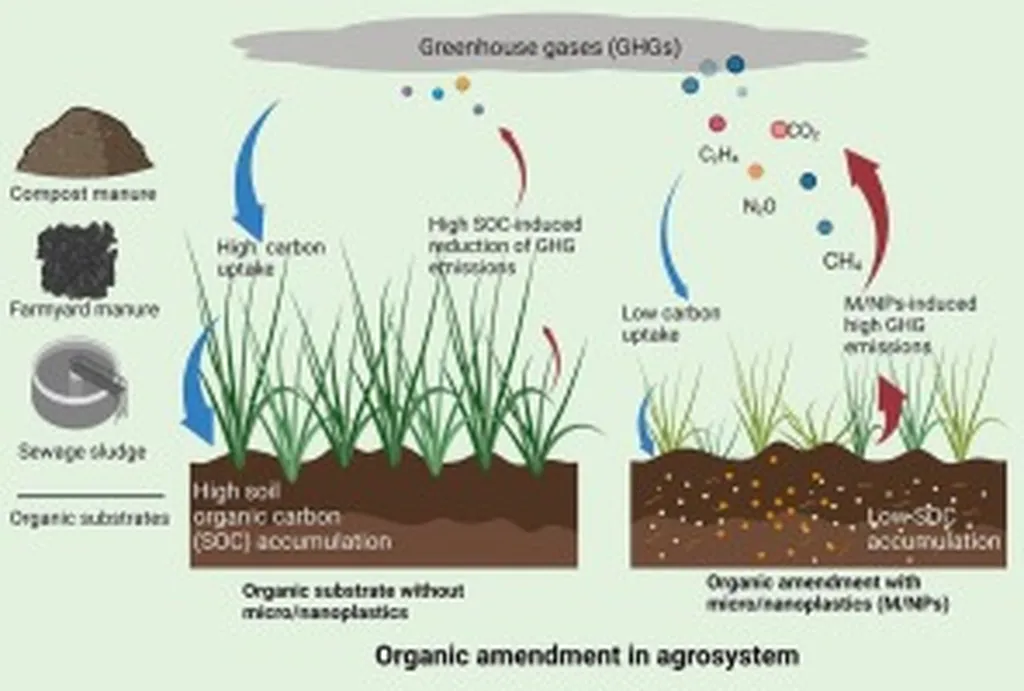
In the quest to bolster soil health and combat climate change, farmers and researchers alike are turning their attention to the power of organic amendments. A recent study published in the *Journal of Agriculture and Food Research* sheds new light on how different organic amendments can influence soil organic carbon (SOC) dynamics, offering promising insights for the agriculture sector.
The research, led by Zhiping Liu from the College of Resources and Environment at Shanxi Agricultural University, investigated the impact of various organic amendments on soil organic carbon, microbial necromass, and plant litter. The study focused on a Calcarie-Fluvie Cambisol under five different fertilizer treatments: unfertilized control, chemical fertilizer alone, cattle manure with chemical fertilizer, pig manure with chemical fertilizer, and maize straw with chemical fertilizer.
The findings revealed that chemical fertilizer alone led to a significant decrease in SOC, amino sugars (indicators of microbial necromass), and plant lignin phenols (indicators of plant litter) compared to the unfertilized control. However, the application of organic amendments in combination with chemical fertilizers resulted in a substantial increase in SOC, total amino sugars, and plant lignin phenols.
“Our results indicate that when organic amendments are applied, lignin is more likely to be retained in the soil, and plant-derived materials make a greater contribution to SOC than microbial necromass,” Liu explained. This suggests that organic amendments can facilitate long-term SOC accumulation, a critical factor in improving soil health and mitigating climate change.
The study also found that the type of organic amendment significantly influenced the composition of SOC. The lignin phenol content varied among the organic amendment treatments, with maize straw and chemical fertilizer (FS) showing the highest levels, followed by cattle manure and chemical fertilizer (FM), and pig manure and chemical fertilizer (FC).
Moreover, the ratio of amino sugars to lignin phenols was significantly lower in the organic amendment treatments compared to the chemical fertilizer treatment, with the FS treatment exhibiting the lowest ratio. This indicates that plant-derived materials play a more significant role in SOC accumulation when organic amendments are applied.
The commercial implications of these findings are substantial. Farmers can potentially enhance soil health and carbon sequestration by incorporating organic amendments into their fertilizer regimens. This not only benefits the environment but also improves soil fertility and crop productivity, leading to increased yields and economic gains.
As the agriculture sector continues to grapple with the challenges of climate change and soil degradation, this research offers a promising avenue for sustainable soil management. By leveraging the power of organic amendments, farmers can contribute to a more resilient and productive agricultural future.
The study, published in the *Journal of Agriculture and Food Research*, was led by Zhiping Liu from the College of Resources and Environment at Shanxi Agricultural University, highlighting the importance of interdisciplinary research in addressing global agricultural challenges.