
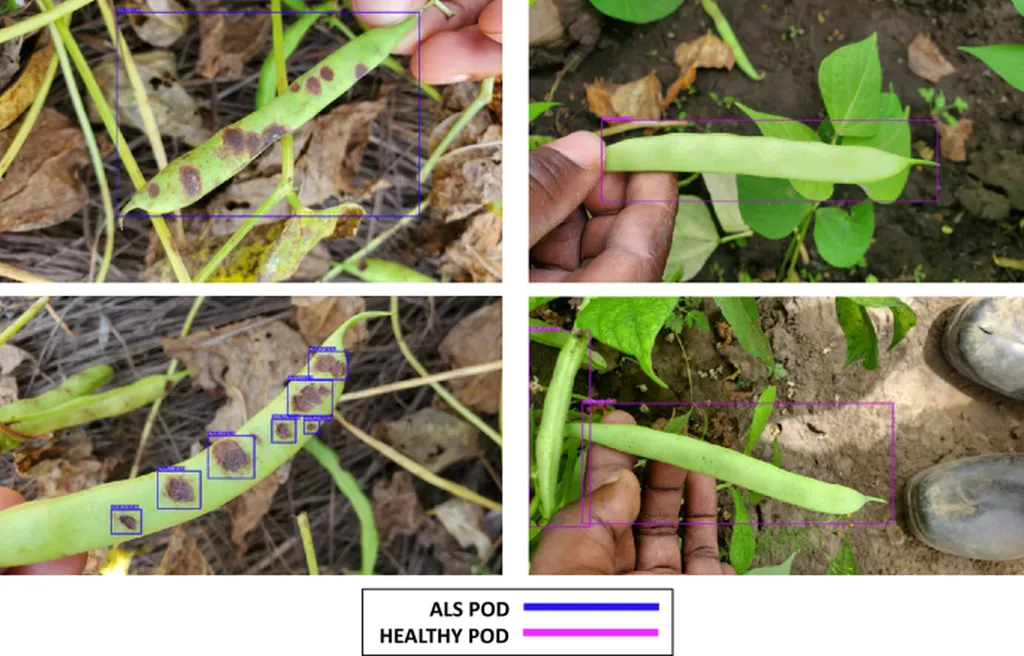
In the ever-evolving landscape of precision agriculture, a novel approach to kidney bean detection has emerged, promising to revolutionize the way farmers monitor and harvest their crops. Researchers have developed the kidneyB-YOLO model, a sophisticated tool designed to tackle the complexities of detecting multiple and occluded kidney beans in open-field trellis cultivation scenarios.
The study, published in *Frontiers in Plant Science*, addresses a critical challenge in modern agriculture: the accurate and efficient detection of bean pods amidst the intricate and often cluttered environment of open-air trellises. Lead author Jianjia Qi and their team have introduced a model that integrates several advanced techniques to enhance detection accuracy and robustness.
The kidneyB-YOLO model stands out due to its innovative components. It employs a dynamic convolution module that adaptively adjusts parameters based on the input, ensuring optimal performance across varying conditions. The Deformable Attention Transformer (DAT) attention mechanism focuses on key regions of the image, effectively filtering out irrelevant information. Additionally, the Adaptively Spatial Feature Fusion (ASFF) detection method filters out conflicting target information, while the Focaler-SIoU loss function combines the SIoU loss function with the Focaler-IoU algorithm to improve detection precision.
The results are impressive. The kidneyB-YOLO model achieved a detection performance of 85.90% mean Average Precision (mAP) with a computational complexity of 12.4 GFLOPs, a model size of 12 MB, and operated at 32.5 frames per second (FPS). These metrics highlight the model’s efficiency and effectiveness in real-world agricultural scenarios.
“The enhancements improved the accuracy and robustness of bean pod detection,” noted Qi. “The model demonstrated strong robustness and generalization capability in the fruit detection task for kidney bean harvesting under open-air trellises.”
The implications for the agriculture sector are substantial. Accurate and efficient detection of bean pods can lead to more precise harvesting, reducing waste and increasing yield. This technology can be integrated into autonomous harvesting systems, enabling farmers to optimize their operations and improve overall productivity.
Moreover, the kidneyB-YOLO model’s adaptability and robustness suggest that it could be applied to other crops and agricultural scenarios. This versatility opens up new possibilities for precision agriculture, paving the way for more efficient and sustainable farming practices.
As the agriculture industry continues to embrace technological advancements, the kidneyB-YOLO model represents a significant step forward. Its ability to handle complex and occluded scenarios makes it a valuable tool for farmers seeking to enhance their operations and stay competitive in an ever-changing market.
In the words of Qi, “This research not only addresses a critical need in kidney bean cultivation but also sets a precedent for future developments in agricultural technology.”
With the publication of this study in *Frontiers in Plant Science*, the agricultural community now has a powerful new tool at its disposal, one that promises to shape the future of farming and contribute to a more sustainable and efficient food production system.