
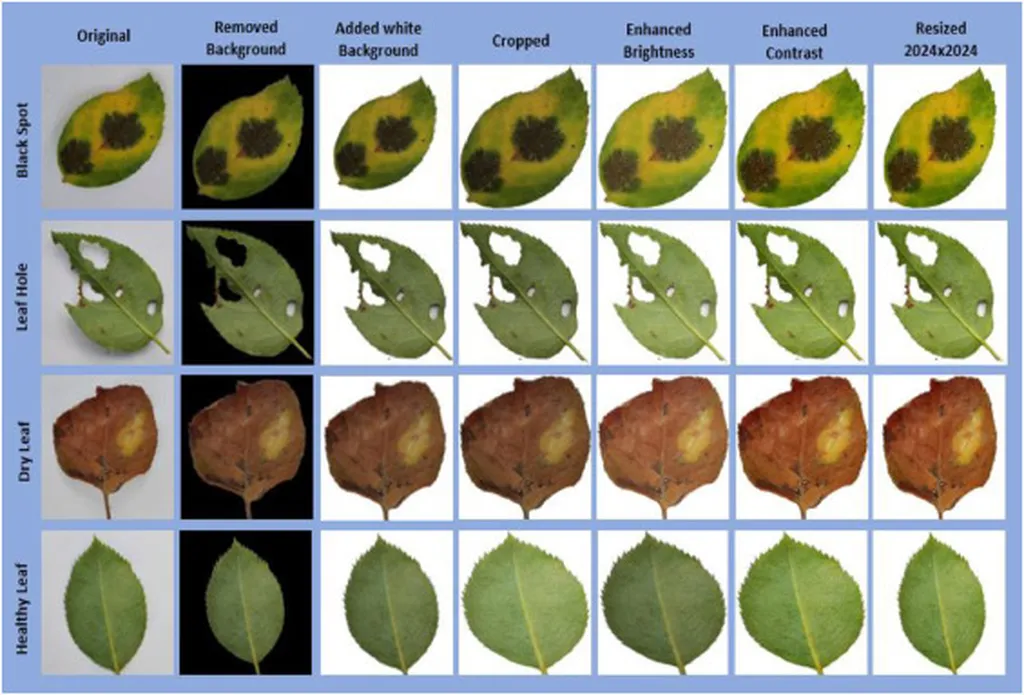
In the heart of Bangladesh, a groundbreaking initiative is taking root, promising to revolutionize the way we combat rose leaf diseases and protect the global agricultural market. A team of researchers, led by Jarin Tasmim Jinia from the Department of Computer Science and Engineering at Daffodil International University, has compiled a comprehensive dataset of rose leaf images, aiming to train AI models for early and accurate disease detection.
The RoseLeafSet dataset, published in ‘Data in Brief’, comprises 10,000 high-quality images captured from various rose gardens across Bangladesh. These images are categorized into four distinct classes: Healthy Leaf, Black Spot, Leaf Hole, and Dry Leaf, representing different stages of disease development. The dataset was collected over a week in late 2024, using a Vivo IQOO Z9x phone to ensure high-resolution imagery.
The significance of this research lies in its potential to mitigate substantial economic losses in the agricultural sector. Roses, being one of the most popular and widely cultivated flowers, contribute significantly to the global market. However, diseases affecting these plants can lead to considerable financial setbacks. “Timely and accurate detection of these diseases is crucial,” Jinia emphasizes. “It can help prevent the spread of infections and save millions of dollars in crop losses.”
The RoseLeafSet dataset serves as a valuable resource for researchers and developers working on creating efficient algorithms for disease identification. By leveraging machine learning and image processing techniques, these algorithms could significantly enhance disease detection and prevention. “Our goal is to develop AI models that can analyze leaf images and provide real-time diagnostics,” Jinia explains. “This could transform the way farmers monitor and manage their crops, leading to more sustainable and profitable agricultural practices.”
The implications of this research extend beyond the agricultural sector. The development of AI-based solutions for plant pathology could pave the way for similar applications in other areas of agriculture, such as smart farming and precision agriculture. As the global population continues to grow, the demand for efficient and sustainable agricultural practices will only increase. Initiatives like RoseLeafSet are stepping stones towards meeting these challenges and securing our future food supply.
In the words of Jinia, “This is just the beginning. With the right tools and technologies, we can make a significant impact on the agricultural sector and contribute to a more sustainable future.” The RoseLeafSet dataset is a testament to the power of interdisciplinary research and the potential of AI to drive positive change in the world.