
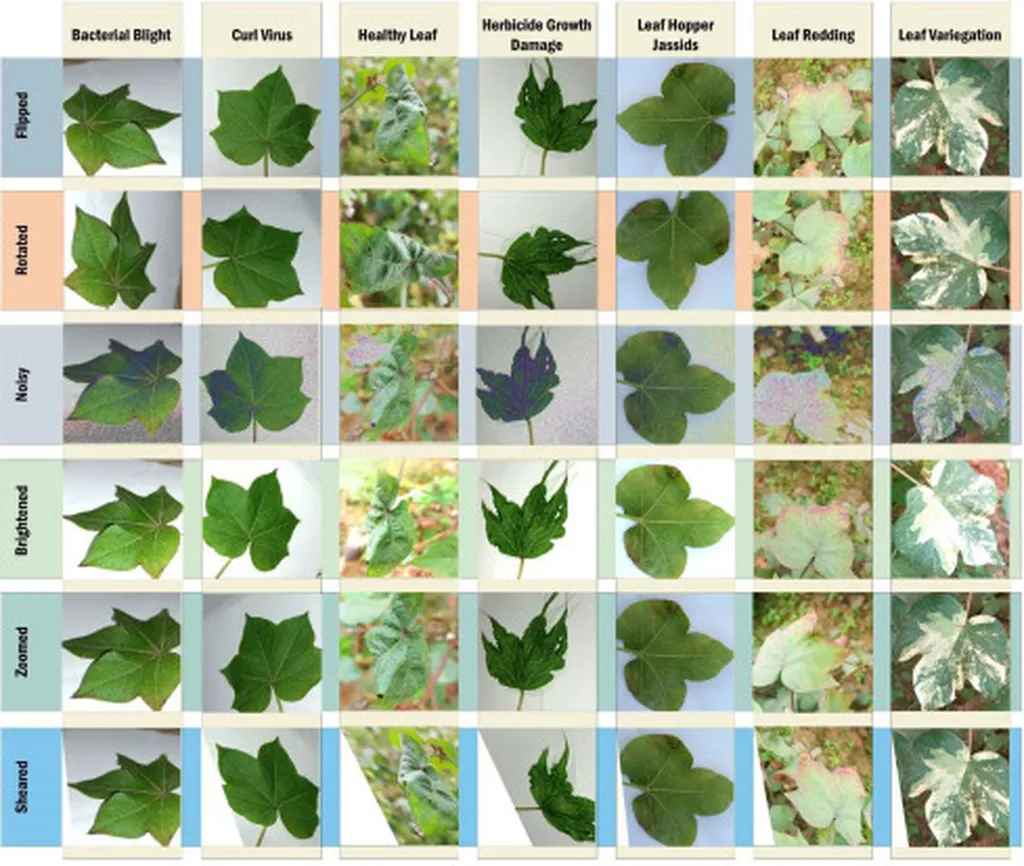
In the heart of Bangladesh, a groundbreaking initiative is taking root, promising to revolutionize the way we monitor and protect one of the world’s most valuable crops: cotton. A new dataset, published in *Data in Brief*, is set to transform disease detection and health monitoring in cotton plants, offering a beacon of hope for farmers and the global textile industry alike.
Cotton, often dubbed “white gold,” is a linchpin of the global economy, supporting around 250 million people worldwide. However, its vulnerability to diseases, particularly leaf diseases, poses a significant threat to yield and fiber quality. Enter Shamim Ripon, a researcher from the Department of Computer Science and Engineering at East West University in Dhaka, Bangladesh. Ripon and his team have meticulously curated an image dataset designed to facilitate early and automated disease detection in cotton plants.
The dataset comprises 1373 original and 4963 augmented high-resolution images of cotton leaves, captured under diverse environmental conditions. These images depict healthy, damaged, and infected leaves, providing a comprehensive visual library for machine learning applications. The dataset focuses on four common cotton leaf diseases—Fusarium wilt, Alternaria leaf spot, Verticillium wilt, and bacterial blight—each meticulously labeled and classified.
“The idea was to create a robust dataset that reflects the natural variability and realism of cotton leaf diseases,” Ripon explains. “By capturing images from different angles and using various devices, we aimed to provide rich visual content that can support the development of strong deep learning models.”
The implications of this research are profound for the agriculture sector. Early disease detection can significantly reduce crop losses, enhancing both yield and fiber quality. This, in turn, can lead to more sustainable cotton-growing methods, benefiting farmers and the environment alike. “Precision agriculture is the future,” Ripon asserts. “By leveraging technology, we can make farming more efficient, sustainable, and profitable.”
The dataset’s potential extends beyond disease classification. It can also support crop health monitoring, enabling farmers to take proactive measures to protect their crops. This proactive approach can lead to a more resilient and productive cotton industry, ultimately benefiting the global textile market.
As we look to the future, this dataset could pave the way for further advancements in agricultural technology. By providing a solid foundation for machine learning and deep learning models, it opens up new avenues for research and innovation in precision agriculture. The possibilities are as vast as they are exciting, promising a future where technology and agriculture intersect to create a more sustainable and prosperous world.
Published in *Data in Brief*, this research is a testament to the power of collaboration and innovation. Led by Shamim Ripon from the Department of Computer Science and Engineering at East West University, it represents a significant step forward in our quest to protect and enhance one of the world’s most valuable crops. As we continue to explore the potential of this dataset, one thing is clear: the future of cotton farming is looking brighter than ever.