
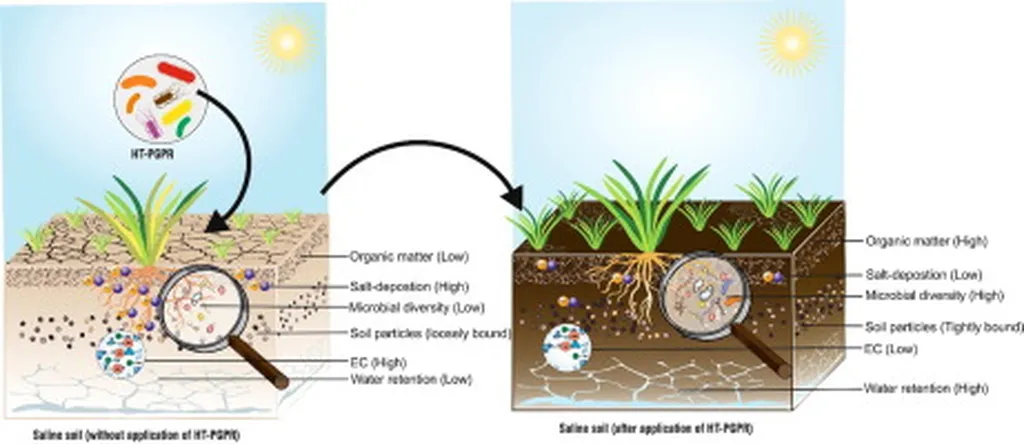
In the quest to combat soil salinity—a pervasive challenge in arid and semi-arid regions—scientists have turned to an innovative approach that combines biopolymer-based microencapsulation and halotolerant plant growth-promoting rhizobacteria (PGPB). This method not only shows promise for rehabilitating saline soils but also for enhancing crop performance, as demonstrated in a recent study published in *Carbohydrate Polymer Technologies and Applications*.
The research, led by Fateme Aghamir from the Department of Agriculture at Shahid Beheshti University in Tehran, Iran, evaluated twelve halotolerant PGPB strains, both as free cells and encapsulated in chitosan–starch microcapsules, with or without organic liquid fertilizer (OLF). The goal was to assess their impact on safflower (Carthamus tinctorius L.) growth and soil desalination in greenhouse trials.
The findings are compelling. Microencapsulation significantly enhanced the viability, colonization, and function of the PGPB. Integrator strains such as Rhizobium sp., Agrobacterium tumefaciens, and Rhizobium radiobacter reduced soil electrical conductivity (EC) by up to 51%, indicating a substantial reduction in salinity. Specialist strains like Pseudomonas fluorescens and Micrococcus luteus boosted targeted metabolites, while persistent strains such as Bacillus licheniformis and Kushneria sp. maintained remediation efforts over time.
“Microencapsulation provided mechanical protection and enzyme stabilization, promoting exopolysaccharide-mediated soil aggregation,” Aghamir explained. This dual approach not only improves plant growth but also contributes to soil health, offering a sustainable solution for saline soil management.
The commercial implications for the agriculture sector are substantial. With large-scale leaching often impractical due to water scarcity and environmental concerns, this biopolymer-based method presents a scalable, low-impact alternative. By enhancing phytoremediation and salinity tolerance, farmers could see improved crop yields and reduced input costs, particularly in regions where soil salinity is a major constraint.
The study’s findings suggest that combining diverse PGPB types with biopolymer encapsulation and organic amendments could revolutionize saline soil management. “This approach offers a promising avenue for sustainable agriculture, particularly in arid and semi-arid regions,” Aghamir noted.
While the research provides a strong foundation, further field validation and biosafety assessments are necessary to ensure its efficacy and safety in real-world applications. Nonetheless, the potential is clear: microencapsulated halophilic PGPB could play a pivotal role in shaping the future of sustainable agriculture, offering a viable solution to one of the sector’s most pressing challenges.
Published in *Carbohydrate Polymer Technologies and Applications*, this research underscores the importance of interdisciplinary approaches in addressing agricultural challenges. As the global population grows and climate change exacerbates environmental stresses, innovative solutions like these will be crucial in ensuring food security and sustainable land use.