
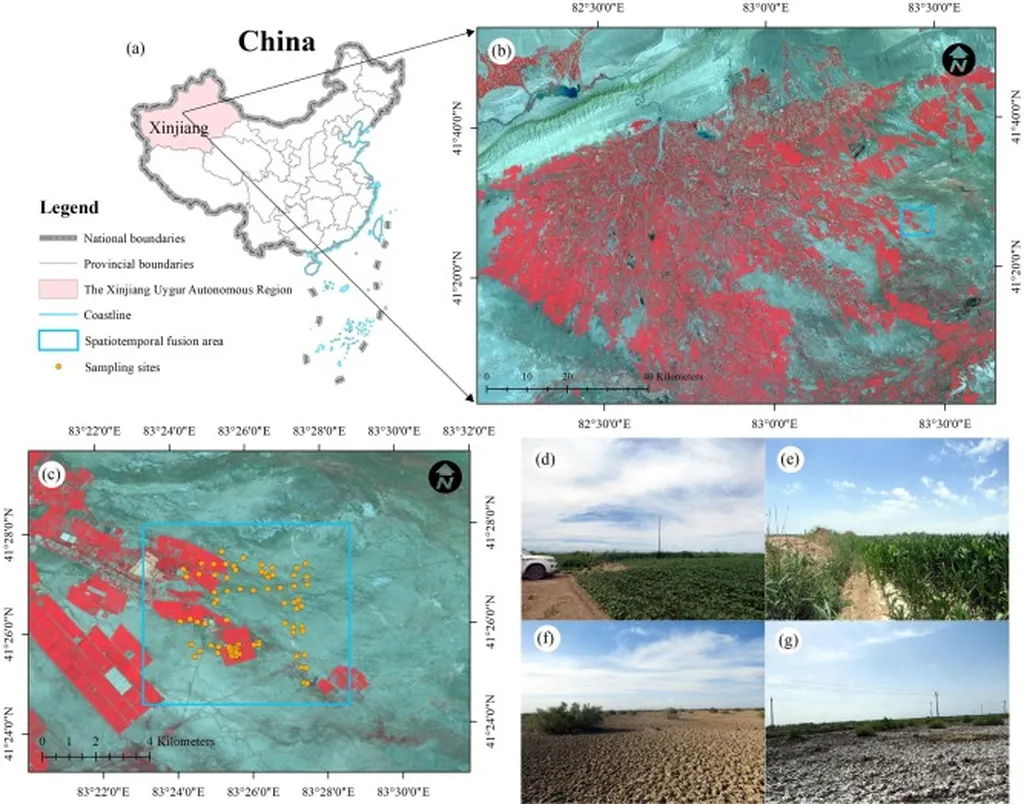
In the heart of Northeast China, a groundbreaking study led by Nan Lin from the Modern Industry College at Jilin Jianzhu University is revolutionizing how we monitor and manage soil salinity, a silent menace to agricultural sustainability. The research, published in *Agricultural Water Management*, combines hyperspectral imaging (HSI) and synthetic aperture radar (SAR) to create a more accurate and reliable method for estimating soil salinity, offering a beacon of hope for farmers and agronomists worldwide.
Soil salinization, a process where salt accumulates in the soil to detrimental levels, affects over 1 billion hectares globally, threatening food security and agricultural productivity. Traditional methods of monitoring soil salinity are often labor-intensive and limited in scope. Enter remote sensing, a technology that allows for large-scale, non-invasive monitoring of soil properties. However, until now, the accuracy of these methods has been hampered by the coupling effects of other soil physical properties.
Lin’s study proposes a novel solution: a multi-scale, multi-depth Wasserstein Generative Adversarial Network with Gradient Penalty (MSD-WGAN-GP) to fuse HSI and SAR data. “The spectral response to soil salinity is highly susceptible to interference from other soil physical properties,” explains Lin. “SAR remote sensing is highly sensitive to these parameters and can effectively compensate for the limitations of HSI.”
The results are promising. The fusion of HSI and SAR data significantly improved the prediction accuracy of soil salinity. The model’s R² and RPIQ increased by 0.22 and 1.13, respectively, while the RMSE decreased by 2.68 ds·m⁻¹. Moreover, the MSD-WGAN-GP model outperformed traditional image fusion methods, achieving a peak signal-to-noise ratio of 38.39 dB and a structural similarity index of 0.88.
The implications for the agriculture sector are substantial. Accurate, large-scale monitoring of soil salinity can inform precision agriculture practices, enabling farmers to optimize irrigation, fertilizer application, and crop selection. This can lead to increased yields, improved resource efficiency, and enhanced sustainability.
Looking ahead, this research paves the way for further exploration of multi-source remote sensing data fusion. As Lin notes, “Integrating multi-source remote sensing data allows us to comprehensively capture the multidimensional characteristics of soil, enabling more accurate estimation of soil properties.” Future developments in this field could see the integration of even more data sources, such as LiDAR or drone-based sensors, further enhancing our understanding of soil health and its impact on agricultural productivity.
In the face of climate change and growing global food demands, innovations like Lin’s are not just welcome; they’re essential. By harnessing the power of remote sensing and advanced machine learning, we can equip our farmers with the tools they need to cultivate a sustainable and productive future.