
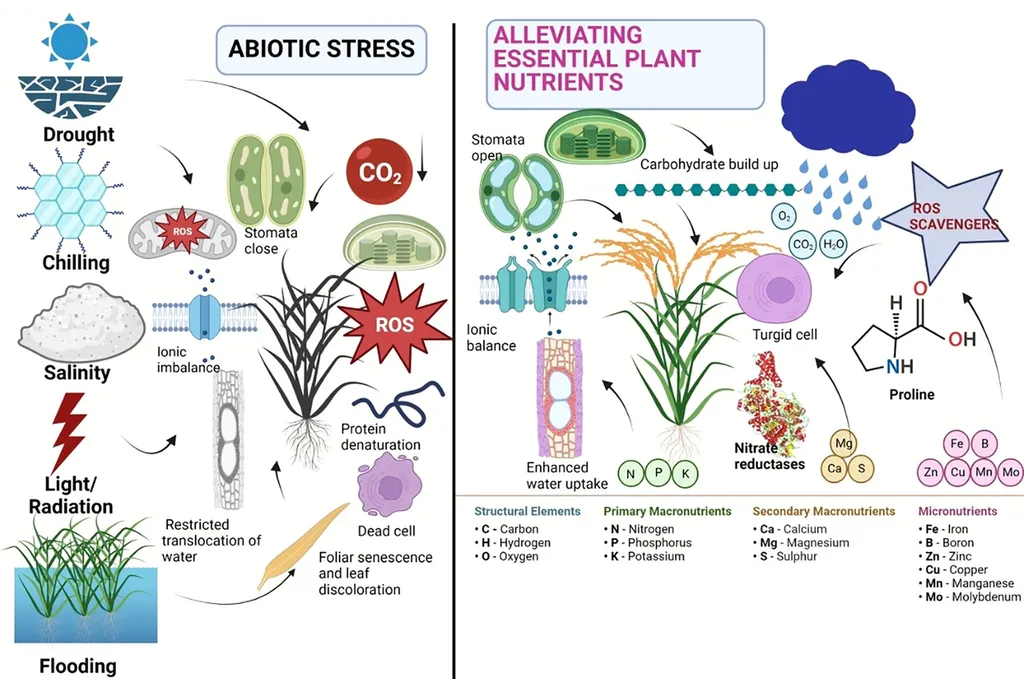
In the ever-changing landscape of agriculture, where climate variability is becoming the norm, understanding how plants respond to environmental stressors is crucial. A recent study published in *Plant Stress* sheds light on the intricate ways phytohormones help plants manage light stress, offering promising avenues for enhancing crop resilience and productivity.
Light, the driving force behind photosynthesis, can also be a source of stress. Both excessive and insufficient light disrupt the delicate balance between energy absorption and utilization, leading to photoinhibition, oxidative stress, and reduced crop yields. “Light stress is a critical abiotic factor that directly limits photosynthetic efficiency and crop yield,” explains Saeedeh Zarbakhsh, lead author of the study and a researcher at the Department of Horticultural Science, College of Agriculture, Shiraz University, Iran.
The study delves into the role of various phytohormones—chemical messengers that regulate plant growth and development—in mitigating light stress. Under high light conditions, hormones like abscisic acid (ABA) and jasmonic acid (JA) ramp up antioxidant defenses, enhance non-photochemical quenching, and boost anthocyanin accumulation, which helps protect plants from oxidative damage. Cytokinins (CKs) play a pivotal role in maintaining photosynthetic efficiency by promoting chloroplast development and repairing photosystem II (PSII), the protein complex crucial for converting light energy into chemical energy.
Conversely, under low light conditions, gibberellins (GAs) and auxins come into play, promoting stem elongation and leaf expansion to optimize light capture. Brassinosteroids (BRs) enhance chlorophyll synthesis and carbon metabolism, while ethylene and ABA work together to regulate leaf angle and shoot–root balance, ensuring plants make the most of the available light.
The study also highlights the complex interplay between these hormonal responses and transcriptional networks, chromatin modifications, and small RNA pathways. This integration enables plants to achieve both short-term protection and long-term acclimation to varying light conditions.
The implications for the agriculture sector are significant. As climate change continues to alter light availability and intensity, understanding and harnessing these phytohormonal pathways could lead to the development of crops with enhanced resilience and productivity. “Future research should focus on phytohormone–epigenome interactions, phytohormone–miRNA crosstalk, and cell-specific responses,” Zarbakhsh suggests. By linking mechanistic knowledge with breeding and management practices, farmers and agronomists could deploy targeted strategies to boost photosynthetic efficiency and crop yields under fluctuating light conditions.
This research not only advances our scientific understanding but also opens the door to innovative agricultural practices. As we grapple with the challenges posed by a changing climate, such insights are invaluable in our quest to secure food supplies and sustain agricultural productivity.