
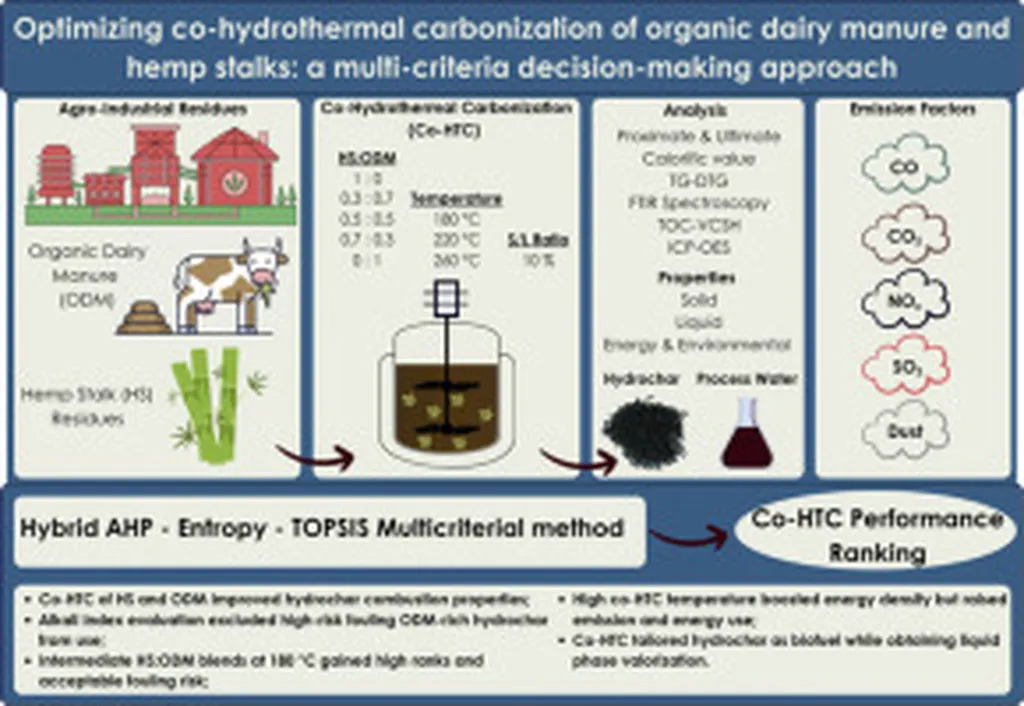
In the quest for sustainable agricultural practices, researchers have turned to an innovative approach that could transform organic waste into valuable biofuels. A recent study published in *Energy Nexus* explores the co-hydrothermal carbonization (co-HTC) of organic dairy manure (ODM) and hemp stalks (HS), offering promising insights for the agriculture sector.
The study, led by Alessandro Cardarelli from the Department of Economics Engineering Society and Business Organization (DEIM) at the University of Tuscia, Italy, investigates how blending these two feedstocks can enhance the combustion performance of hydrochar—a solid fuel derived from hydrothermal carbonization. The research team conducted experiments at varying temperatures and feedstock ratios to evaluate the physicochemical properties, combustion behavior, and emission factors of the resulting hydrochars.
“Our findings demonstrate clear synergistic effects when co-processing dairy manure and hemp stalks,” Cardarelli explained. “By optimizing the blend ratios and processing conditions, we can produce hydrochars with improved energy yield and combustion reactivity, making them more viable for practical applications.”
The study employed a hybrid Analytic Hierarchy Process (AHP) – Entropy – TOPSIS multicriteria analysis to rank the hydrochars based on technical, environmental, and process-related indicators. This systematic approach allowed the researchers to identify the most promising hydrochars for combustion, balancing performance and operational feasibility.
One of the key challenges addressed in the study is the risk of fouling, which can hinder the practical use of hydrochars in combustion processes. The researchers found that while some hydrochars exhibited high performance scores, their Alkali Index (AI) levels exceeded the safe threshold for fouling. However, they identified two hydrochars, HY180–0.3:0.7 and HY180–0.7:0.3, that combined high multi-criteria performance with acceptable AI levels, making them suitable for practical combustion applications.
The implications of this research for the agriculture sector are significant. By valorizing agricultural residues into efficient biofuels, farmers and agribusinesses can reduce waste, generate additional revenue streams, and contribute to a more sustainable and circular economy. The study highlights the potential of co-HTC to tailor hydrochar properties by leveraging complementary feedstock characteristics, paving the way for innovative waste-to-energy solutions.
As the demand for environmental sustainability practices continues to grow, this research offers a promising pathway for the agriculture sector to embrace cleaner energy carriers and reduce its carbon footprint. By integrating multi-criteria decision-making with fouling risk assessment, the study provides a robust framework for optimizing hydrochar production and supporting sustainable waste management practices.
In the words of Cardarelli, “This approach not only advances our understanding of hydrothermal carbonization but also strengthens the role of hydrochar as a clean energy carrier, contributing to renewable fuel production, circular waste management, and emission mitigation.”
As the agriculture sector seeks to balance productivity with sustainability, the insights from this study could shape future developments in biofuel production and waste management, ultimately fostering a more resilient and eco-friendly agricultural landscape.