
In the ever-evolving landscape of agriculture, the adoption of smart technologies is not just a matter of accessibility or economic viability—it’s a complex dance of social interactions, trust networks, and individual decision-making. A groundbreaking study published in *Scientific Reports* sheds light on this intricate process, offering a new tool to predict how farmers might embrace technological innovations. The research, led by Yahya S. Alotibi from the Department of Agricultural Extension and Rural Society at King Saud University, introduces AdoptAgriSim, a socio-technical agent-based simulation model that could revolutionize how we understand and promote smart agriculture.
Traditional models of technology adoption in agriculture have often fallen short, relying on static frameworks that fail to capture the dynamic, interconnected nature of farmer decision-making. “Existing approaches overlook the critical role of social learning and trust networks,” Alotibi explains. “This oversight limits our ability to design effective policies and deployment strategies.” AdoptAgriSim changes the game by integrating economic, social, and technological dimensions into a unified framework. Using multi-agent reinforcement learning and socio-economic network modeling, the model simulates how individual farmers, peer networks, and market forces interact during the diffusion of technology.
The implications for the agriculture sector are profound. By accurately predicting adoption dynamics, AdoptAgriSim can help stakeholders identify the most effective strategies for promoting smart agriculture technologies. “Our model shows that social factors contribute 34% more to adoption variance than previously estimated,” Alotibi notes. “This underscores the importance of peer influence and trust networks in accelerating technology diffusion.” For policymakers and technology designers, this means that strengthening social connectivity and implementing targeted network interventions could substantially speed up the adoption of sustainable agricultural practices.
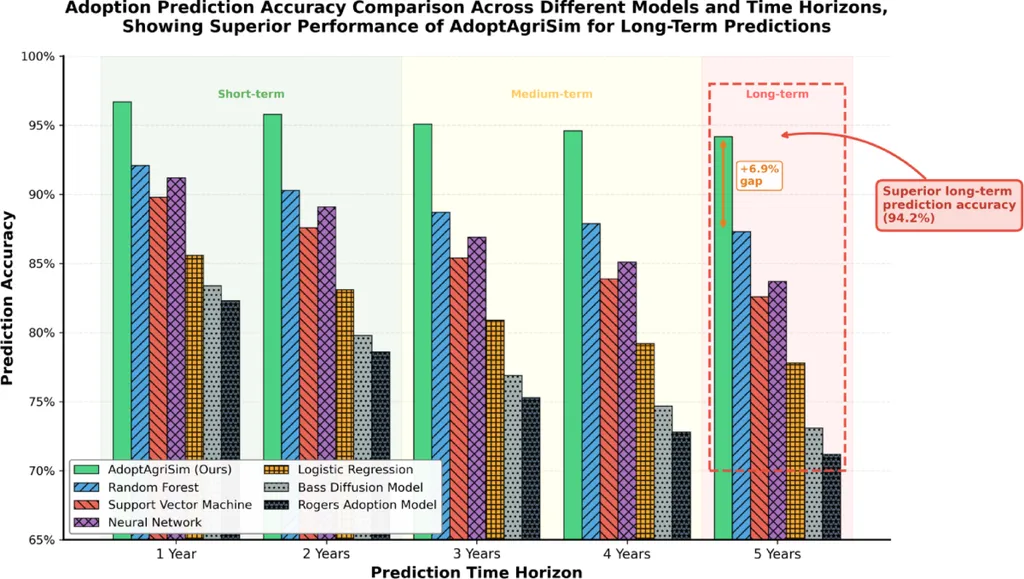
The model’s predictive accuracy is impressive, achieving 94.2% accuracy for five-year adoption intervals across diverse agricultural contexts in Iowa (USA), Europe, and India. This level of precision allows for a deeper understanding of emergent adoption behaviors, such as technology clustering and peer-driven influence cascades. “AdoptAgriSim reproduces region-specific diffusion trajectories, providing valuable insights for tailored interventions,” Alotibi adds.
As the agriculture sector continues to grapple with the challenges of sustainability and productivity, tools like AdoptAgriSim offer a beacon of hope. By bridging the gap between socio-technical factors and economic reasoning, this research paves the way for more informed decision-making and strategic planning. The future of smart agriculture lies not just in the technology itself, but in the intricate web of social and economic interactions that drive its adoption. With AdoptAgriSim, we are one step closer to unlocking the full potential of agricultural innovation.