
In the heart of China’s litchi orchards, a technological revolution is underway, promising to transform the way farmers and breeders select and cultivate this prized fruit. A groundbreaking study, published in *Plant Methods*, introduces LitchiPhenoNet, a multimodal learning framework designed to tackle the unique challenges of litchi phenotyping. This innovation could significantly enhance the efficiency and accuracy of litchi breeding programs, with far-reaching implications for the agriculture sector.
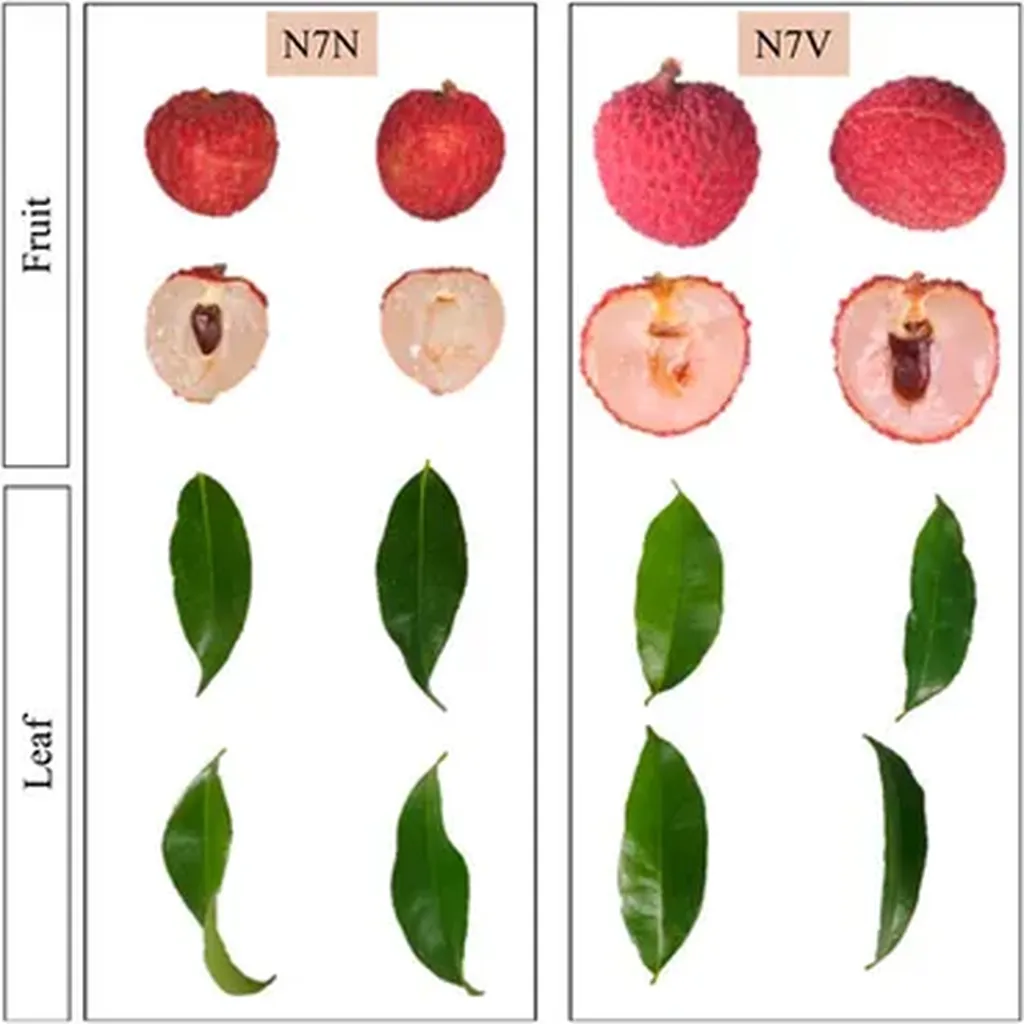
Litchi, with its spiny, variable pericarp and diverse seed morphology, has long posed a challenge for traditional phenotyping methods. Manual measurements of key traits such as horizontal and vertical diameters, as well as the weights of both fruit and pit, are not only laborious and inefficient but also subjective. This inconsistency can hinder the selection of elite cultivars and the advancement of breeding research. Enter LitchiPhenoNet, a dual-branch architecture that integrates RGB (color/texture) and depth (spatial/structural) information to provide a more precise and automated solution.
The framework’s RD-Fusion module addresses the inherent semantic and scale inconsistencies between modalities, improving robustness under complex and variable pericarp surfaces. “This technology allows us to handle fine-scale surface relief and cross-cultivar variability, which is crucial for accurate phenotyping,” explains lead author Mingchao Yang from the Institute of Tropical Fruit Trees, Hainan Academy of Agricultural Sciences.
The implications for the agriculture sector are substantial. High-throughput phenotyping enabled by LitchiPhenoNet can accelerate breeding programs, leading to the faster development of elite litchi cultivars with desirable traits. This efficiency gain can translate into significant commercial benefits, including increased yield, improved fruit quality, and enhanced market competitiveness.
Comparative experiments have shown that LitchiPhenoNet consistently outperforms leading YOLO-based models, achieving millimeter-level diameter estimation with coefficients of determination approaching 0.98 and mean errors within 2 mm. For weight estimation, gram-level precision is attained across whole fruit, pit, and pulp, with coefficients of determination up to 0.98 and mean errors comparable to repeated manual measurements.
The scalability of this technology is another key advantage. As Yang notes, “The framework is readily extensible to other textured fruits, making it a versatile tool for high-throughput phenotyping in various breeding programs.” This adaptability could revolutionize phenotyping practices across the agriculture sector, paving the way for more objective and efficient phenotypic analysis.
In the broader context, LitchiPhenoNet exemplifies the power of multimodal learning in addressing complex agricultural challenges. By integrating different types of data, this framework provides a more comprehensive and accurate understanding of phenotypic traits, which is essential for advancing breeding research and improving crop performance.
As the agriculture sector continues to embrace technological innovations, tools like LitchiPhenoNet will play a pivotal role in shaping the future of crop breeding and selection. The study, led by Mingchao Yang and affiliated with the Institute of Tropical Fruit Trees, Hainan Academy of Agricultural Sciences, represents a significant step forward in this exciting journey. With its potential to enhance efficiency, accuracy, and scalability, LitchiPhenoNet is poised to make a lasting impact on the agriculture sector and beyond.