
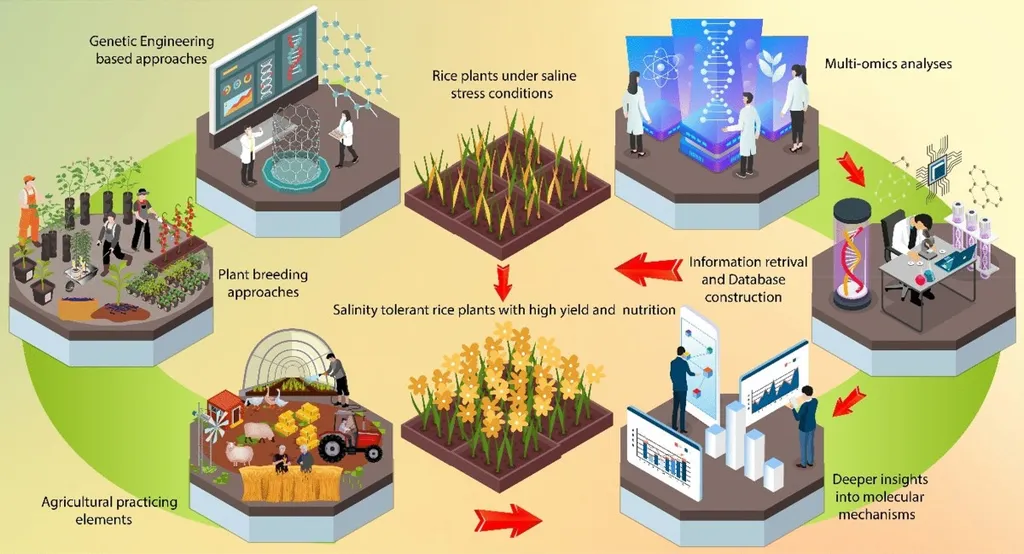
In the face of escalating climate change and environmental challenges, crops are increasingly subjected to abiotic stresses such as extreme temperatures, water scarcity, and metal toxicity. These stresses, exacerbated by human activities and urbanization, threaten agricultural productivity and food security. However, a recent study published in *Discover Plants* offers a promising pathway to enhance crop resilience through an integrative multi-omics approach.
The research, led by Tikam Chand Dakal from the Department of Biotechnology at Mohanlal Sukhadia University, delves into the intricate molecular, cellular, and morphological changes plants undergo in response to abiotic stress. These changes include the generation of reactive oxygen species (ROS), stomatal movements, fluctuations in cytosolic calcium ion concentrations, activation of potassium channels, metabolite production, and stress-responsive gene expression.
“Understanding these responses at a molecular level is crucial for developing stress-resilient crops,” Dakal explains. “By integrating genomics, transcriptomics, epigenomics, and metabolomics, we can uncover the complex networks that govern plant stress responses.”
The study highlights the advancements in plant genomics, which have identified key genes, quantitative trait loci (QTLs), and regulatory networks involved in stress perception, signal transduction, and adaptive responses. Epigenomic studies have revealed dynamic gene expression regulation through DNA methylation, histone modifications, and small RNAs, which fine-tune stress-responsive gene expression and memory. Metabolomic profiling, validated by techniques such as liquid chromatography–mass spectrometry (LC–MS/MS), has identified metabolic pathways and molecular signatures associated with stress acclimation and resilience.
The researchers propose a comprehensive strategy that combines these multi-omics approaches with CRISPR-based genome editing and high-throughput phenotyping. This integrative approach aims to accelerate the discovery of stress-resilient traits, providing a powerful framework to unravel complex stress response networks and identify potential targets for genetic improvement.
“CRISPR enables precise editing of stress-responsive genes, while phenotyping platforms allow rapid screening of multi-trait responses under field conditions,” Dakal notes. “This synergistic application of plant genomics, epigenomics, and metabolomics is driving forward our understanding of plant stress biology.”
The implications for the agriculture sector are significant. By enhancing crop resilience to abiotic stresses, this research could lead to increased yields and improved food security, even in the face of adverse environmental conditions. The commercial impact could be substantial, as farmers and agribusinesses adopt these advanced breeding techniques to develop more robust and productive crop varieties.
As climate change continues to pose challenges to global agriculture, the insights gained from this research offer a beacon of hope. The integrative multi-omics approach not only deepens our understanding of plant stress biology but also paves the way for sustainable agricultural practices that can withstand the pressures of a changing climate.
In the words of Dakal, “This integrated knowledge opens new avenues for sustainable agriculture, ensuring food security and resilience in the face of environmental challenges.”