
In the ever-evolving landscape of agricultural technology, a groundbreaking review published in *Discover Plants* is set to reshape how we think about ethylene management in crops and postharvest systems. Led by Olanrewaju Ayodeji Durojaye of the Drug Discovery and Biotechnology Unit at the University of Nigeria, the research delves into the potential of synthetic protein strategies to modulate ethylene pathways, offering new tools for farmers, floriculturists, and postharvest managers.
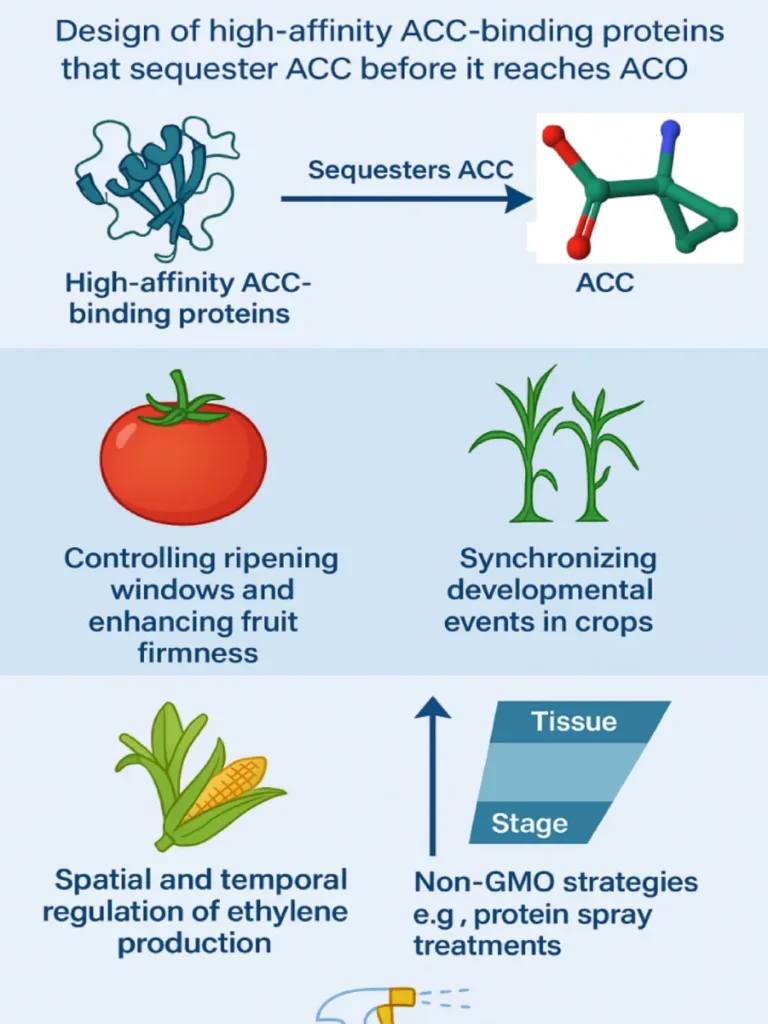
Ethylene, a critical phytohormone, plays a central role in ripening, senescence, and stress responses in plants. Traditionally, managing ethylene has relied on chemical inhibitors, gene silencing, or controlled atmospheres. However, these methods often lack precision and can be costly or environmentally harmful. The review highlights three emerging modalities that could revolutionize ethylene management: synthetic regulators of ACC oxidase (ACO), ACC-binding or sequestration proteins, and genetically encoded biosensors for real-time monitoring.
“By reprogramming ethylene biosynthesis through de novo protein design, we can achieve more tunable, orthogonal, and plant-system-compatible solutions,” Durojaye explains. This approach promises to extend the shelf life of produce, reduce postharvest waste, and enhance crop resilience. The review also emphasizes the potential for these tools to be deployed through transgenic expression, transient vectors, or non-GMO protein formulations, making them versatile for various agricultural applications.
One of the most promising areas for near-term commercial impact is postharvest management and floriculture. “Modest, reversible shifts in ethylene flux can significantly extend the quality window of perishable goods, reducing waste and improving marketability,” Durojaye notes. This could translate into substantial economic benefits for farmers and supply chain operators, particularly in industries where freshness is paramount.
However, the path to widespread adoption is not without challenges. Scalable, cost-effective biomanufacturing, shelf-stable formulations, and practical delivery methods (such as sprays, sachets, or coatings) are critical hurdles that must be overcome. Additionally, ensuring the stability and activity of these proteins in planta and on commodity surfaces, along with addressing ecotoxicology and regulatory compliance, will be essential for commercial success.
The research also underscores the importance of aligning these innovations with existing regulatory frameworks, such as the EU-1107 for biopesticides. “Early alignment with regulatory pathways will be key to translating these promising designs into deployable, regulator-ready tools,” Durojaye states.
As the agricultural sector continues to seek sustainable and efficient solutions, this review offers a glimpse into a future where synthetic biology could play a pivotal role. By harnessing the power of de novo protein design, farmers and postharvest managers may soon have access to tools that are not only more precise but also environmentally friendly and economically viable. The journey from lab to field is fraught with challenges, but the potential rewards—reduced waste, improved crop yields, and enhanced food security—make it a pursuit worth undertaking.
For those in the agricultural technology space, this research signals a shift toward more sophisticated, bio-based solutions that could redefine ethylene management. As Durojaye and his colleagues continue to refine these strategies, the agricultural sector stands on the brink of a new era, one where synthetic biology could unlock unprecedented levels of efficiency and sustainability.