
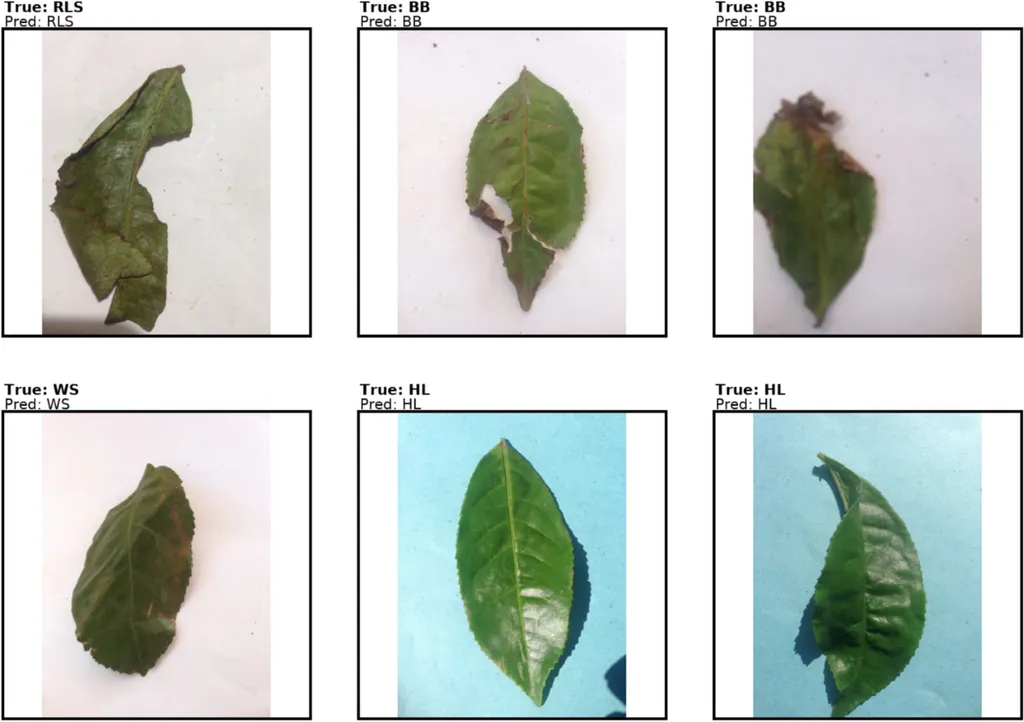
In the heart of precision agriculture, a groundbreaking development is brewing, one that could redefine how we protect and nurture one of the world’s most beloved crops: tea. Researchers have unveiled TeaLeafNet-GWO, an intelligent deep learning framework designed to detect tea leaf diseases with remarkable accuracy. This innovation, published in *Discover Artificial Intelligence*, promises to revolutionize disease monitoring, offering substantial benefits to the agriculture sector.
Tea cultivation is a cornerstone of economic and agricultural stability, particularly in developing countries. However, the industry faces a significant challenge: foliar diseases that can decimate crops if left unchecked. Traditional detection methods, often manual and time-consuming, lack the precision needed for early-stage identification across multiple disease types. Enter TeaLeafNet-GWO, a hybrid model that combines the spatial feature extraction power of Convolutional Neural Networks (CNNs) with the global contextual awareness of Transformer blocks, enhanced by Gray Wolf Optimization (GWO) for hyperparameter tuning.
The model’s architecture is a marvel of modern machine learning. It integrates MobileViT, a lightweight Transformer, with a squeeze-and-excitation network (SENet) for channel-wise recalibration. This combination allows the model to capture both local and global features of tea leaf images, ensuring accurate disease classification. The dataset used for training comprises 999 high-resolution images representing eight distinct tea leaf conditions, including both healthy and diseased classes. Preprocessing techniques such as contrast-limited adaptive histogram equalization (CLAHE) and median filtering were applied to enhance image quality and suppress noise.
The results are impressive. TeaLeafNet-GWO achieved an average accuracy of 97.72%, an F1-score of 86.66%, and a Matthews correlation coefficient (MCC) of 84.44% in the training phase, with similarly high performance in testing. These metrics outperform several state-of-the-art hybrid models, demonstrating the framework’s effectiveness as a lightweight, scalable, and accurate solution for real-time disease monitoring.
The commercial implications for the agriculture sector are profound. “This technology can significantly reduce crop losses and improve the quality of tea leaves, ultimately benefiting farmers and the entire supply chain,” said lead author Md Firoz Kabir, a Master of Science in Information Technology student at the University of the Cumberlands. By enabling early detection and precise diagnosis, TeaLeafNet-GWO can help farmers take timely action, minimizing the impact of diseases on their crops.
The potential applications extend beyond tea cultivation. The hybrid CNN-Transformer architecture, coupled with GWO, could be adapted for other crops, making it a versatile tool in the precision agriculture toolkit. As the world grapples with the challenges of climate change and food security, such innovations are crucial for sustainable and efficient farming practices.
TeaLeafNet-GWO represents a significant step forward in the field of agritech. Its success underscores the importance of integrating advanced machine learning techniques with traditional agricultural practices. As researchers continue to refine and expand this technology, we can expect to see even greater advancements in disease detection and management, paving the way for a more resilient and productive agricultural future.