
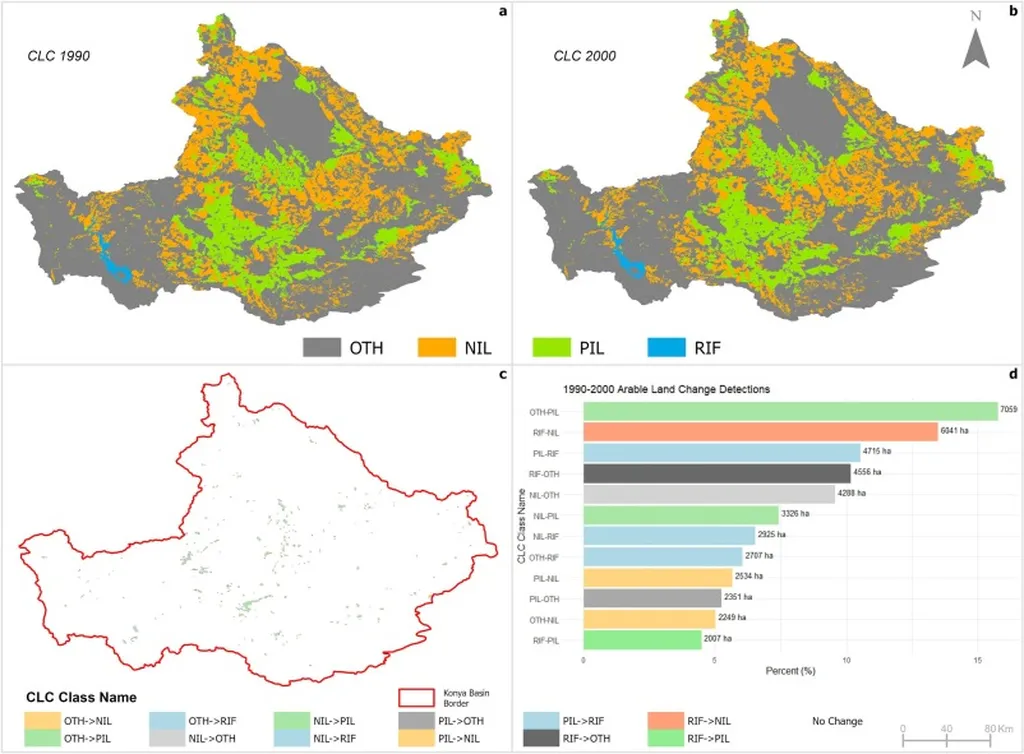
In the heart of Türkiye’s Central Anatolia Region lies the Konya Closed Basin, a vast expanse of land that could hold the key to boosting wheat production in a country grappling with urbanization and increasing food demands. A recent study published in the *Journal of Agricultural Sciences* has employed a sophisticated hybrid approach to identify the most suitable lands for wheat cultivation, potentially reshaping agricultural strategies and investments in the region.
The research, led by Aydan Yaman from Aksaray University, integrates Geographic Information Systems (GIS) and the Analytic Hierarchy Process (AHP), a multi-criteria decision-making (MCDM) technique, to evaluate land suitability. The study delineates 15 criteria under four main categories: meteorological, topographic, soil, and infrastructure and economic factors. “The most effective criteria were determined as the average temperature of October, followed by the average annual temperature and the land use capability,” Yaman explains.
The findings are promising. The study reveals that 61.24% of the study area is highly suitable for wheat cultivation, with districts like Kadinhani, Sarayonu, and Altinekin emerging as particularly favorable regions. This detailed mapping could significantly impact the agriculture sector by guiding farmers and investors towards the most productive lands, thereby optimizing resource allocation and increasing yields.
The commercial implications are substantial. By identifying precise and suitable areas for wheat cultivation, the study aims to enhance agricultural productivity and sustainability. “This study presents a new research perspective by considering the uncertainty in the site selection process and the concept of sustainability in four different dimensions,” Yaman notes. This holistic approach could influence future agricultural policies and practices, ensuring that land use is both efficient and environmentally responsible.
The study also addresses a gap in the current literature by examining the average annual pressure criterion, a factor not extensively explored in previous research. This addition underscores the importance of comprehensive data analysis in agricultural planning.
As the global population grows and food demands escalate, the need for sustainable and efficient agricultural practices becomes ever more critical. This research not only provides a roadmap for wheat cultivation in the Konya Closed Basin but also sets a precedent for similar studies in other regions. By combining GIS and AHP, the study offers a robust methodology that could be adapted to various agricultural contexts, ultimately contributing to food security and economic growth.
In an era where data-driven decisions are paramount, this research stands out as a beacon of innovation in the field of agritech. As the agriculture sector continues to evolve, the integration of advanced technologies and comprehensive analysis will be key to meeting the challenges of the future.