
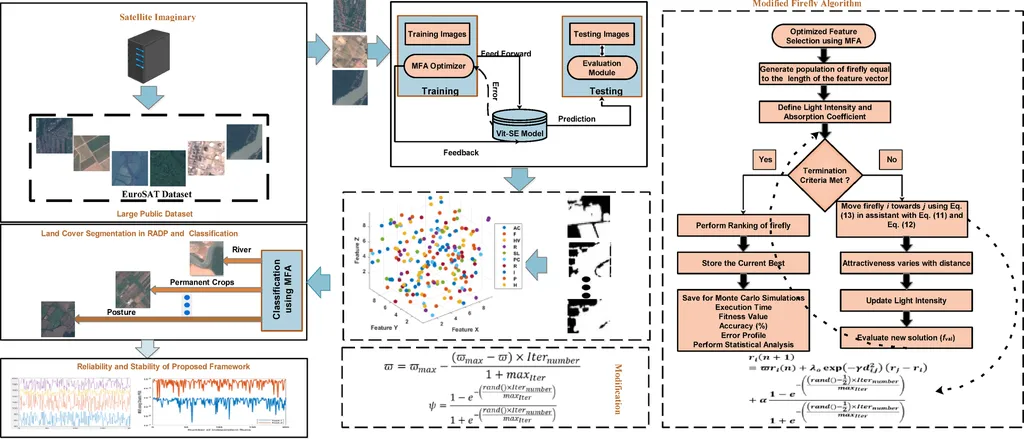
In the ever-evolving landscape of precision agriculture, a groundbreaking study published in the *Journal of Agricultural Sciences* is set to revolutionize how we monitor and classify agricultural land use. Led by Kemal Çelik from Gümüşhane Üniversitesi, the research delves into the optimization of advanced deep learning architectures, particularly Vision Transformer (ViT) models, to enhance the accuracy and efficiency of agricultural land-use classification.
The study addresses a critical challenge in modern agriculture: the precise classification of land use and land cover through remote sensing images. This task is essential for ensuring food security, estimating yields, and planning efficient exports. However, the varied and evolving characteristics of agricultural environments have made this a complex endeavor. Çelik and his team aimed to tackle this issue by evaluating and optimizing ViT models, including ViTBase-16, DeiT-Tiny, and EfficientNet-B0.
One of the most significant findings of the study is the remarkable accuracy achieved by the optimized ViT algorithm. “Our optimized ViT algorithm consistently achieved classification accuracy exceeding 99% on a newly assembled dataset containing around 200 samples of Google Earth imagery,” Çelik explained. This level of precision is a game-changer for the agriculture sector, enabling more accurate monitoring and management of agricultural lands.
The research also highlights the practical implications of these findings. By compressing the ViTBase model by pruning 50% of its layers, the team significantly reduced computational complexity while maintaining competitive accuracy of 97.9% on the SIRI-WHU dataset. This makes the models particularly suitable for deployment on devices with limited computational resources, supporting real-world operational agricultural monitoring systems.
The commercial impacts of this research are substantial. Farmers and agricultural businesses can leverage these optimized models to gain deeper insights into land use and cover, leading to more informed decision-making. This can result in improved crop yields, better resource management, and enhanced overall productivity. Additionally, the ability to deploy these models on resource-constrained devices opens up new possibilities for small-scale farmers and agricultural cooperatives, democratizing access to advanced agricultural technologies.
Looking ahead, this research paves the way for future developments in precision agriculture. The optimized transformer-based models offer scalable and efficient solutions specifically designed for agricultural applications. As the field continues to evolve, these models can be further refined and adapted to meet the unique challenges and opportunities presented by different agricultural environments.
In summary, the study led by Kemal Çelik from Gümüşhane Üniversitesi represents a significant advancement in the field of agricultural land-use classification. By optimizing deep learning architectures, the research not only enhances the accuracy and efficiency of land-use monitoring but also opens up new commercial opportunities for the agriculture sector. As we look to the future, these findings are poised to shape the next generation of precision agriculture technologies, driving innovation and sustainability in the industry.