
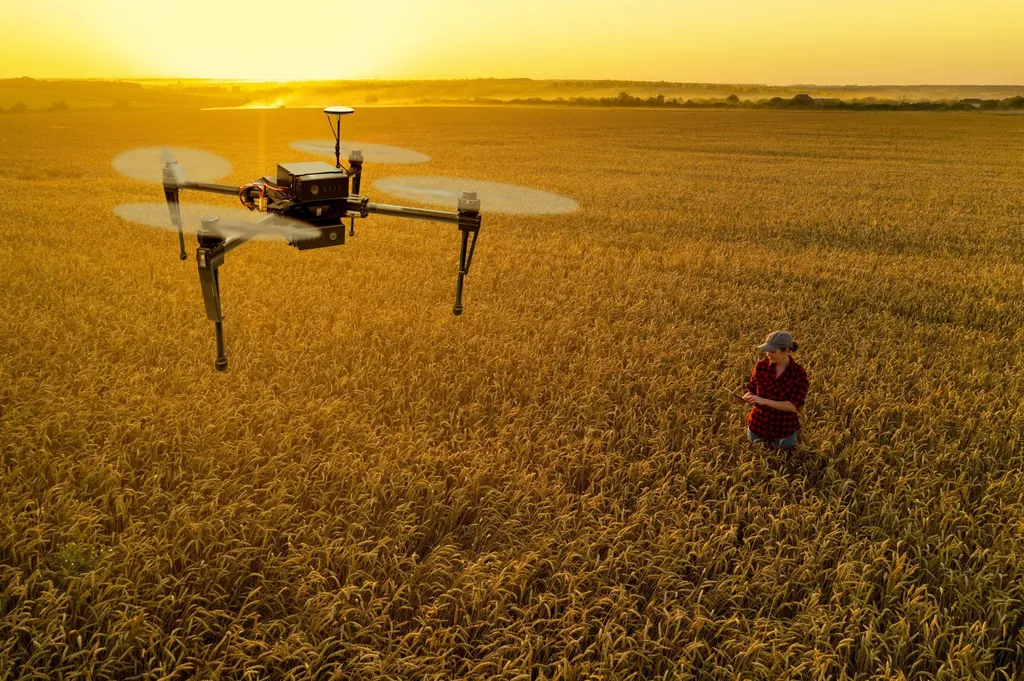
In the quest for precision agriculture, researchers have turned to the skies for a novel approach to monitoring wheat crops. A recent study published in *Frontiers in Plant Science* has harnessed the power of unmanned aerial vehicles (UAVs) and machine learning to estimate the nitrogen nutrition index (NNI) in wheat, offering a promising tool for farmers to optimize nitrogen fertilizer application and planting density.
The study, led by Chao Zhang from the Key Laboratory of Modern Agricultural Equipment, Ministry of Agriculture and Rural Affairs in Nanjing, China, employed UAVs to capture multispectral imagery of wheat canopies at critical growth stages. By analyzing vegetation indices derived from these images, the researchers constructed a robust model to estimate NNI, which is crucial for assessing wheat growth conditions.
“Monitoring nitrogen nutrition indices is vital for understanding the current growth status of wheat and making informed decisions about fertilizer application,” Zhang explained. The research revealed that specific vegetation indices, such as DVI, MDD, NGI, MEVI, NDVI, EVI, and ENDVI, demonstrated strong resistance to interference, enabling the construction of highly accurate models.
The findings indicated that the optimal NNI estimation model was achieved under a nitrogen application rate of 210 kg/hm², with an R² value of 0.785 and an RMSE of 0.137. Additionally, the study found that NNI generally increased and then decreased as planting density increased, providing valuable insights into the effects of planting density on wheat growth.
The commercial implications of this research are significant. By accurately estimating NNI, farmers can optimize nitrogen fertilizer application, reducing costs and environmental impact while enhancing crop yield. “This model not only helps in assessing the growth status of wheat but also provides a reference for rationally determining planting density and nitrogen application levels,” Zhang noted.
The integration of UAV technology and machine learning in agriculture represents a leap forward in precision farming. As the agriculture sector continues to embrace technological advancements, such innovations are poised to revolutionize crop management practices. The study’s findings could pave the way for more efficient and sustainable agricultural practices, ultimately benefiting both farmers and the environment.
This research not only highlights the potential of UAVs and machine learning in agriculture but also underscores the importance of data-driven decision-making in modern farming. As the agriculture sector continues to evolve, the integration of advanced technologies will be crucial in meeting the growing demand for food while minimizing environmental impact. The study’s findings offer a glimpse into the future of precision agriculture, where data and technology converge to optimize crop management and enhance sustainability.