
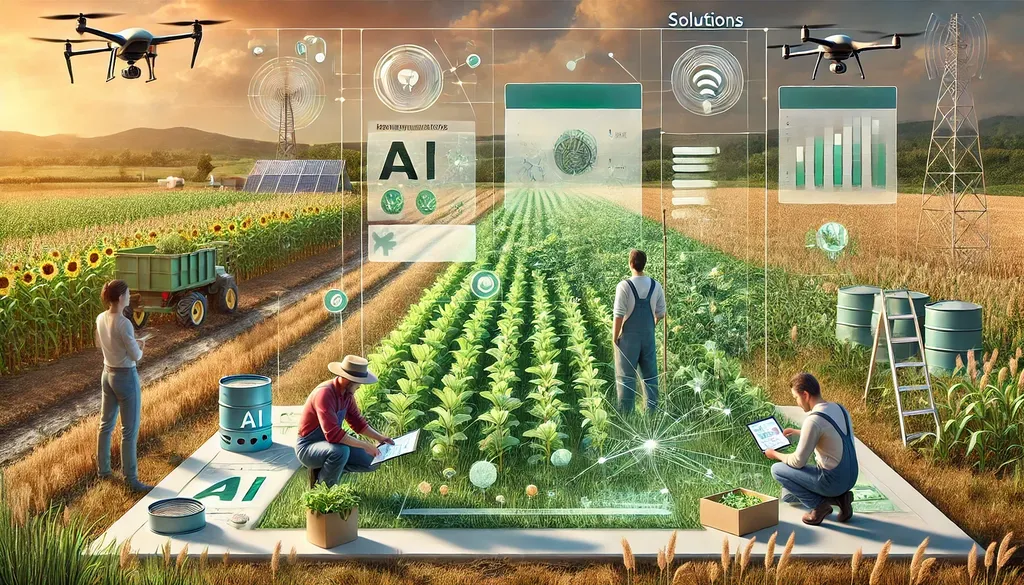
In the relentless pursuit of sustainable agriculture, researchers have developed a novel hybrid deep learning model that promises to revolutionize weed detection and classification. This advancement, published in *Frontiers in Plant Science*, addresses long-standing challenges in precision agriculture, offering a robust solution that could significantly enhance crop yields and operational efficiency.
The study, led by Muhammad Faizan Zeb from the Department of Computer Science at Iqra National University Peshawar, introduces a hybrid model that combines YOLOv7 for weed detection and AlexNet for weed species classification. This fusion aims to overcome the limitations of existing methods, which often struggle with distinguishing crops from similar-looking weeds, inconsistent performance across weed growth stages, and sensitivity to operational constraints.
“We aimed to create a system that not only detects weeds accurately but also classifies them with high specificity,” said Zeb. “The hybrid model leverages the strengths of both YOLOv7 and AlexNet to achieve this goal.”
YOLOv7 was chosen for its fast recognition capabilities and ability to discriminate with better granularity, particularly in dense environments. AlexNet, on the other hand, enhances the system’s specificity by accurately classifying weed species. The experimental results of the hybrid model demonstrated significant improvements over previous methods, achieving a precision of 0.80, recall of 0.85, F1 score of 0.87, [email protected] of 0.89, and [email protected]:0.95 of 0.50. In field tests, AlexNet achieved precision, recall, and F1 scores of 95%, 97%, and 94%, respectively.
The implications for the agriculture sector are profound. Accurate and efficient weed detection and classification can lead to targeted herbicide application, reducing chemical usage and environmental impact. This precision can also enhance crop yields by minimizing competition for resources between crops and weeds. Moreover, the system’s real-time capabilities enable farmers to make timely decisions, optimizing their operations and reducing labor costs.
“This research marks a significant step forward in precision agriculture,” said Zeb. “By integrating advanced deep learning techniques, we can provide farmers with tools that enhance their productivity and sustainability.”
The next phase of the research involves expanding the dataset to include a wider variety of weed species and environmental conditions. The team also plans to validate the developed model by deploying the YOLOv7-AlexNet hybrid model on field computers, thereby expanding its practical application in production environments.
As the agriculture sector continues to embrace technological advancements, this research paves the way for more intelligent and efficient farming practices. The hybrid model’s success highlights the potential of deep learning in addressing long-standing agricultural challenges, offering a glimpse into a future where technology and sustainability go hand in hand.