
In the quest to improve soil health and agricultural productivity, researchers have long grappled with the challenge of accurately predicting soil organic matter (OM) in red soils. A significant hurdle has been the presence of free iron oxides (Fed), which can skew the results of visible and near-infrared (Vis-NIR) reflectance spectroscopy, a commonly used method for soil analysis. However, a recent study published in *Geoderma* offers a promising solution to this longstanding problem.
The research, led by Nuo-Xi Qiu from the State Key Laboratory of Soil and Sustainable Agriculture at the Institute of Soil Science, Chinese Academy of Sciences, and the University of Chinese Academy of Sciences, explores how the influence of Fed can be mitigated to enhance the accuracy of OM prediction. The study utilized a diverse set of 36 red soil samples, including both Fed- and OM-removed samples, to investigate the spectral characteristics of Fed and OM.
One of the key innovations in this study is the application of the maximum overlapping discrete wavelet transform (MODWT) to extract wavelengths associated with Fed spectral features across different wavelet components. “By removing these Fed spectral features from the red soil spectra, we were able to significantly improve the accuracy of OM prediction,” Qiu explained. This finding has profound implications for the agricultural sector, where precise soil analysis is crucial for optimizing crop yields and implementing sustainable farming practices.
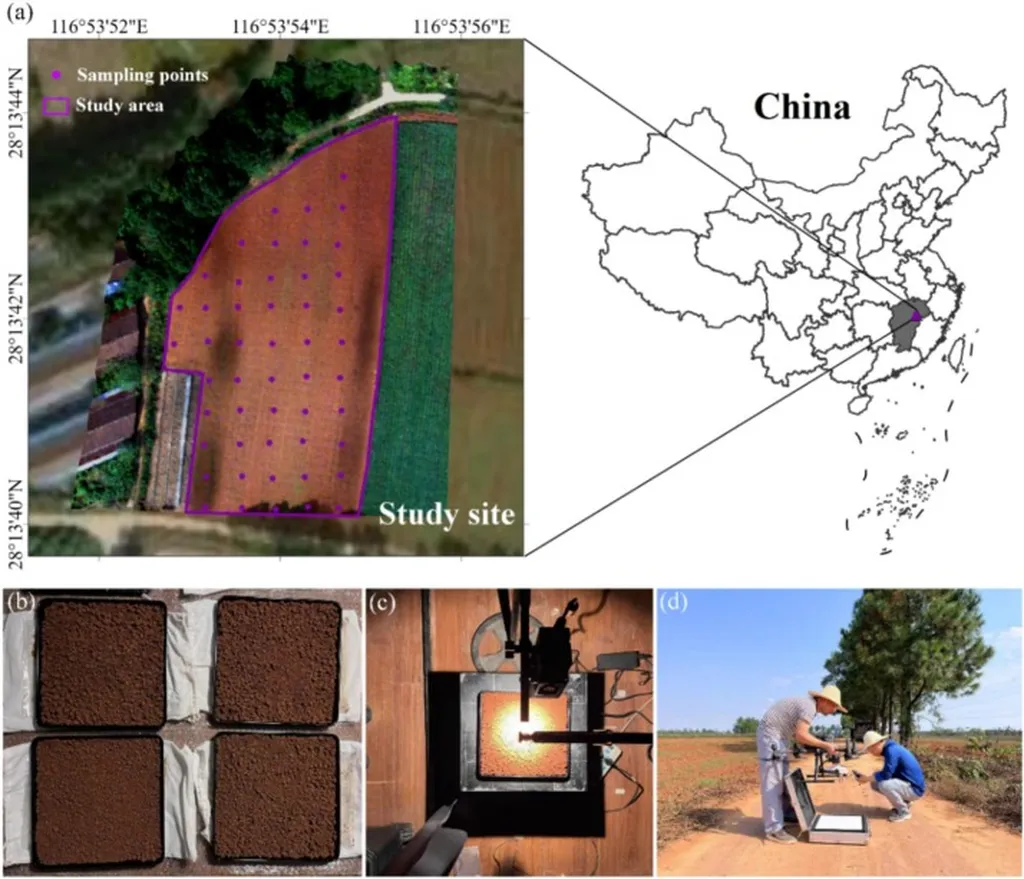
The researchers evaluated the effectiveness of their approach using three distinct datasets: a regional-scale, laboratory-measured dry soil spectral dataset; a field-scale, laboratory-measured moist soil spectral dataset; and a field-scale, unmanned aerial vehicle-measured soil spectral imaging dataset. Three calibration algorithms—partial least squares regression (PLSR), linear support vector machine (LSVM), and random forest (RF)—were employed for OM prediction. The results were striking. Compared to raw spectra, preprocessing via Fed spectral feature removal improved the prediction accuracy of OM in red soils across all datasets and algorithms tested. The average percentage improvement in RMSEval-ori was 19.63%, and in R2val-ori, it was a remarkable 93.80%, with absolute values increasing by an average of 0.21.
The implications of this research extend beyond the laboratory. “Our findings demonstrate the transferability of the feature extraction parameters across different application scenarios,” Qiu noted. This means that the method could be applied in various real-world settings, from large-scale agricultural fields to remote sensing applications, enhancing the precision and reliability of soil analysis.
For the agriculture sector, the ability to accurately predict soil organic matter is a game-changer. It enables farmers and agronomists to make data-driven decisions about soil management, fertilizer application, and crop rotation, ultimately leading to increased productivity and sustainability. The study’s findings could also pave the way for more advanced soil sensing technologies, integrating both proximal and remote sensing methods to provide comprehensive soil health assessments.
As the agricultural industry continues to evolve, the need for precise and reliable soil analysis tools becomes ever more critical. This research represents a significant step forward in addressing the challenges posed by free iron oxides in red soils, offering a robust method to enhance the accuracy of OM prediction. With further development and application, this approach could revolutionize soil management practices, benefiting farmers, researchers, and the environment alike.