
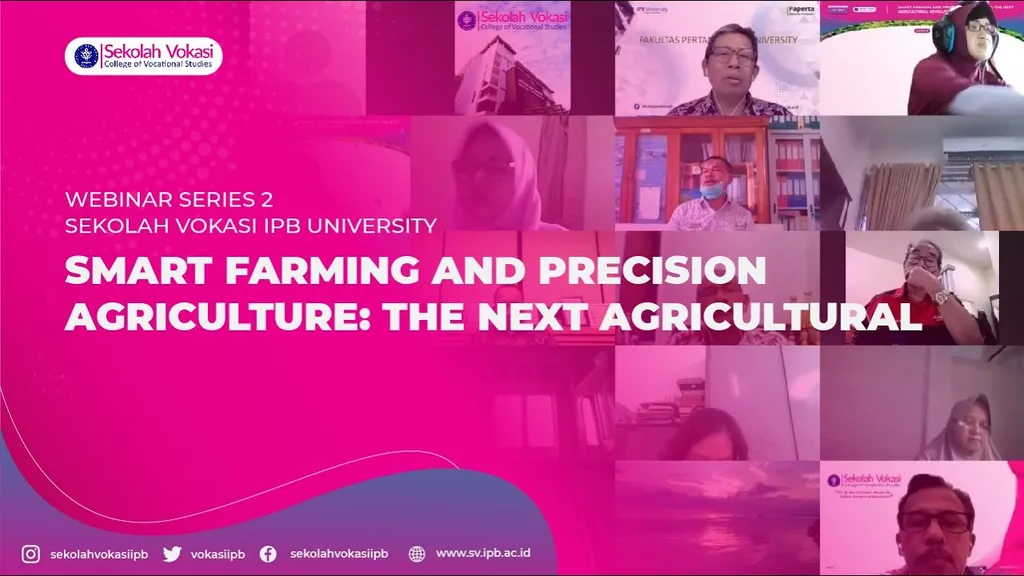
The Center for Plant Phenotyping and Controlled Environment Agriculture (CPP-CEA) at IPB University recently hosted an international webinar, bringing together leading experts from Japan to discuss the latest innovations in smart environmental control technology and real-time plant physiology monitoring. The event underscored the strategic role of CPP-CEA in advancing agricultural technology and fostering international collaboration.
Prof Aris Purwanto, Vice Dean of Resources, Cooperation, and Development at the Faculty of Agricultural Technology, IPB University, emphasized the center’s mission during his opening remarks. “CPP-CEA is a leading research center that integrates sensing, modeling, and automation technologies to increase crop productivity and food security,” he stated. The webinar not only enriched academic discussions but also paved the way for long-term research collaborations between IPB University and its Japanese counterparts. Prof Aris encouraged all participants to actively engage in discussions, exchange ideas, and build research networks to drive innovation in sustainable agriculture.
Dr Slamet Widodo, head of CPP-CEA, introduced two new research facilities developed through a collaboration between IPB University and South Korean research partners: smart greenhouses and indoor vertical farming. These facilities are set to become crucial infrastructure for advancing research in plant phenotyping and controlled environment agriculture technology. “These two facilities will be important infrastructure for the development of research related to plant phenotyping and controlled environment agriculture technology,” said Dr Slamet, who is also a lecturer in the Department of Mechanical and Biosystems Engineering at IPB University.
The first speaker, Prof Kotaro Takayama from Toyohashi University of Technology and Ehime University, highlighted the urgency of environment-controlled production systems, such as intelligent greenhouses and indoor farming, to meet the growing demand for stable and high-quality fresh vegetables. He emphasized the importance of plant-guided control, an approach that regulates the environment based on plant physiological responses rather than just environmental parameters. Prof Takayama introduced a real-time photosynthesis and transpiration monitoring system featuring an open-chamber design. “This physiological data enables early detection of plant stress, such as invisible drought, while helping farmers assess additional light requirements and optimize CO₂ needs,” he explained. He also presented advancements in imaging robotics to monitor plant growth distribution, which is essential for balancing vegetative and generative growth.
Associate Prof Naomichi Fujiuchi from Ehime University discussed whole-plant photosynthesis and transpiration monitoring technology, which is already being used in commercial greenhouses in Japan to support cultivation decision-making. “By analyzing the relationship between plant responses to environmental variables such as light radiation and humidity deficit, researchers can identify physiological anomalies and detect plant stress quantitatively,” he explained. He also showcased mathematical models and automatic stress detection algorithms that reduce reliance on expert intuition, making greenhouse management more objective and efficient.
In an additional session, Dr Taufiq from Toyohashi University of Technology introduced a handy-type photosynthesis measurement system, a portable device designed to facilitate field measurements of photosynthesis and transpiration for agricultural practitioners. “With its light weight, complete sensors, and measurement capabilities under both natural and artificial light, this device is expected to be a practical solution for direct monitoring of plant responses,” he explained.
In conclusion, Dr Slamet Widodo stressed the importance of leveraging plant physiology technology to boost productivity and profitability in controlled environment agriculture (CEA) systems. He highlighted that international collaboration and technological advancements are key to transforming agriculture into a more precise, efficient, and sustainable system. The webinar not only showcased cutting-edge technologies but also reinforced the commitment of IPB University and its partners to advancing agricultural innovation on a global scale.