
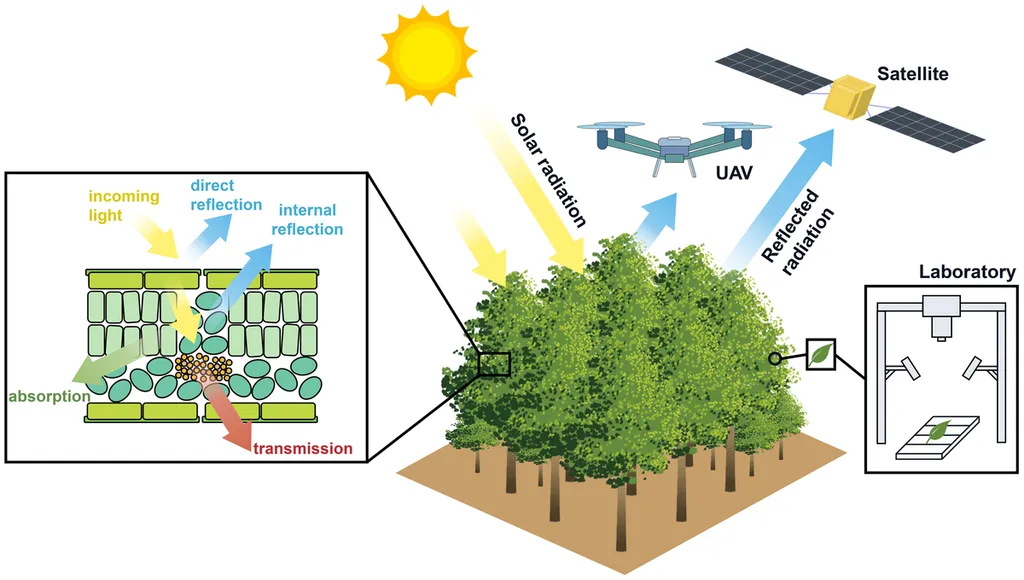
In the quest to safeguard sesame crops from devastating diseases, a team of researchers led by Tae-An Kang from the Department of Upland Crop Research and Development at the National Institute of Crop Science in South Korea has made a significant breakthrough. Their study, published in *Frontiers in Sustainable Food Systems*, introduces a novel approach to early disease detection using hyperspectral imaging and machine learning, potentially revolutionizing disease management in sesame farming.
Sesame (Sesamum indicum L.) is a valuable crop, but it is highly susceptible to leaf blight caused by Corynespora cassiicola and bacterial leaf spot caused by Pseudomonas syringae. These diseases can lead to substantial yield and quality losses, posing a significant challenge to farmers. Traditional detection methods rely on post-symptom diagnosis, which often limits the window for timely intervention. “Early asymptomatic detection is essential for stable production and economic sustainability,” Kang emphasizes.
The research team developed a hyperspectral imaging framework integrated with machine learning algorithms to address this challenge. By implementing a 3×3 patch-based approach, they captured spatial–spectral disease patterns, including infected areas and surrounding healthy tissues. This method enables effective early disease detection, even before visual symptoms appear.
Hyperspectral images were acquired using dedicated equipment, covering a spectral range from 450 to 950 nm. The team evaluated three preprocessing methods—Raw reflectance spectra, Savitzky–Golay (SG) smoothing, and 1st derivative—and employed wavelength selection techniques like the Sequential Projection Algorithm (SPA), Genetic Algorithm (GA), and Competitive Adaptive Resampling (CARS). Feature extraction included spectral features such as mean, standard deviation, and range, along with vegetation indices like NDVI, RCI, PRI, ARI, and PSRI.
The study found that the SG-SPA-SVM and Raw-GA-SVM models achieved the highest classification performance, each with 97.8% accuracy on the test set. “Our framework enabled early asymptomatic diagnosis as soon as 1 day post-inoculation, preceding visual symptom development,” Kang notes. This early detection capability is a game-changer for farmers, allowing them to take preventive measures before the disease spreads.
The commercial implications of this research are substantial. Early detection of diseases can lead to more targeted and efficient use of pesticides, reducing costs and environmental impact. It also supports precision agriculture, a growing trend in the agricultural sector aimed at optimizing crop yields while minimizing resource use. “Integrating hyperspectral imaging with patch-based spatial–spectral analysis and machine learning enables accurate, early, and pathogen-specific detection of sesame leaf diseases,” Kang explains. This approach not only improves disease management but also supports sustainable sesame production.
The reduced wavelength requirements of the GA-based approach make it feasible for developing lightweight, cost-effective multispectral sensors. This advancement could make the technology more accessible to farmers, further promoting its adoption in the agricultural sector.
As the agricultural industry continues to embrace technology, this research paves the way for future developments in disease detection and management. The integration of hyperspectral imaging and machine learning holds promise for other crops as well, potentially transforming how farmers monitor and protect their crops. “This study is a significant step forward in precision agriculture,” Kang concludes. “It demonstrates the potential of advanced technologies to enhance crop health and sustainability.”
With the increasing demand for sustainable and efficient agricultural practices, this research offers a glimpse into the future of farming, where technology plays a pivotal role in ensuring food security and economic stability.