
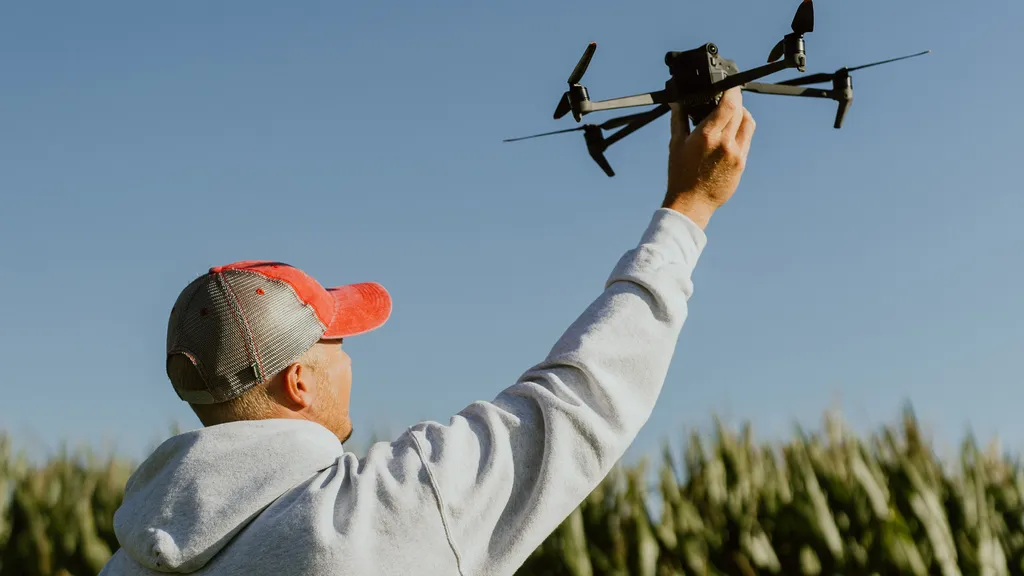
In the ever-evolving landscape of precision agriculture, a new study published in *Frontiers in Robotics and AI* introduces a custom-built uncrewed aerial vehicle (UAV) that could redefine how farmers monitor and manage their fields. Developed by a team led by Veera Venkata Ram Murali Krishna Rao Muvva from the Department of Biological Systems Engineering at the University of Nebraska–Lincoln, this UAV is designed to be modular, adaptable, and affordable—qualities that set it apart from commercial alternatives.
Unlike many off-the-shelf drones restricted by proprietary systems, this UAV offers full customization and advanced autonomy capabilities. At its core, the system integrates a Cube Blue flight controller for low-level control and a Raspberry Pi 4 companion computer that runs a Model Predictive Control (MPC) algorithm for high-level trajectory optimization. This approach replaces conventional PID controllers with an optimal control strategy, enabling the UAV to navigate complex trajectories with precision.
The research team tested the UAV in both simulated and real-world environments, including static and dynamic waypoint tracking, as well as more intricate paths like figure-eights and curved trajectories. The results were impressive: the UAV consistently achieved root mean square error values between 8 and 20 cm, even in wind-disturbed conditions. The system also successfully followed a moving uncrewed ground vehicle (UGV) along nonlinear, curved paths, demonstrating its potential for real-time coordination in agricultural operations.
“This UAV isn’t just about flying from point A to point B,” said Muvva. “It’s about adapting to dynamic environments, optimizing its path in real time, and coordinating with other autonomous systems—all of which are critical for modern farming.”
The implications for the agriculture sector are significant. Farmers increasingly rely on drones for tasks like crop monitoring, irrigation management, and pesticide application. A customizable, autonomous UAV that can adapt to changing conditions and coordinate with ground-based systems could enhance efficiency and reduce operational costs. The ability to track dynamic trajectories—such as following a moving UGV—opens up possibilities for coordinated precision agriculture, where multiple autonomous systems work in tandem to optimize field operations.
Beyond its immediate applications, this research could shape future developments in agricultural robotics. The use of Model Predictive Control (MPC) and Kalman filtering for adaptive mission planning suggests a shift toward more intelligent, self-optimizing systems. As Muvva explained, “The goal is to create a platform that can evolve with the needs of farmers, whether that means integrating new sensors, adapting to different crop types, or coordinating with other autonomous machines.”
While the study highlights the UAV’s capabilities, it also acknowledges challenges, such as the need for further refinement in handling more complex trajectories. However, the results are a promising step toward a future where autonomous systems play a central role in sustainable and efficient agriculture.
As the agriculture sector continues to embrace technology, innovations like this custom UAV could become a cornerstone of precision farming, offering farmers a flexible, cost-effective tool to navigate the complexities of modern agriculture.