
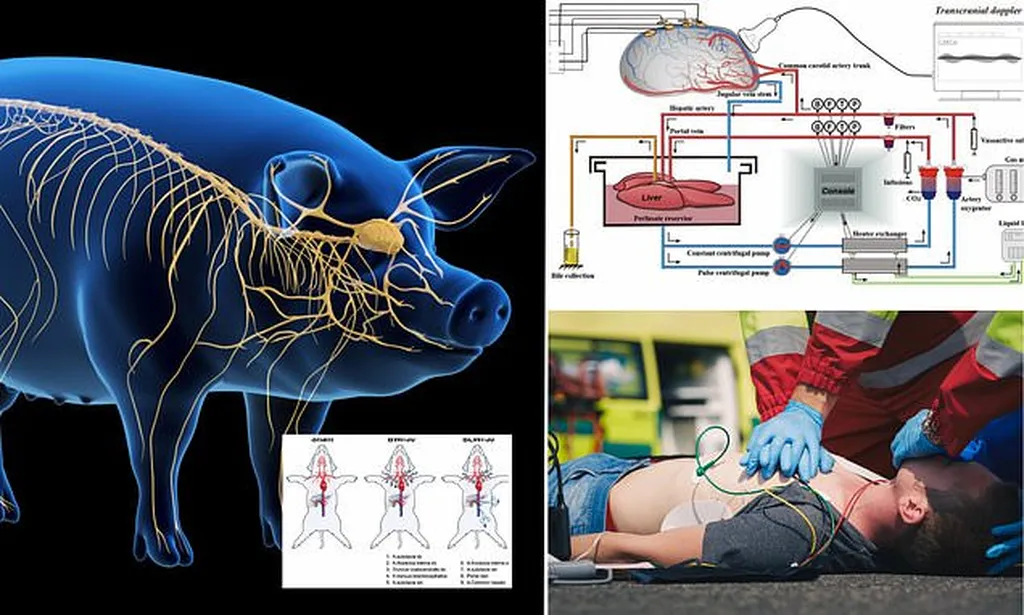
In the realm of agricultural technology, understanding the intricate biomechanics of animal tissues can pave the way for innovative advancements. A recent study published in *Cyborg and Bionic Systems* has shed light on the regional variations in the mechanical properties of porcine leptomeninges, offering insights that could have significant implications for the agriculture sector.
The leptomeninges, the delicate membranes surrounding the brain, play a crucial role in dissipating external forces and maintaining neuroimmune homeostasis. Chenyi Lei, the lead author from Shenzhen International Graduate School at Tsinghua University, and his team conducted a comprehensive study to characterize the mechanical properties of porcine leptomeninges. Their findings reveal a complex biomechanical architecture that varies significantly across different regions of the brain.
Using rheological shear modeling and atomic force microscopy indentation experiments, the researchers discovered that the modulus of the cerebellar lobe region is much higher than that of other lobes of the pia mater. This regional variation in mechanical properties was further characterized by analyzing the spatial distribution of protein compositions, including collagen, elastin, and cell junction proteins. The cerebellum lobe exhibited markedly elevated levels of these proteins, along with a greater thickness compared to other lobes.
“This study underscores the need to analyze the heterogeneities of the leptomeninges when modeling finite element (FE) models or other computational models during traumatic brain injury,” Lei explained. The implications of this research extend beyond the realm of neuroscience, offering valuable insights for the agriculture sector.
In the context of agricultural technology, understanding the biomechanical properties of animal tissues can lead to the development of more effective and humane practices. For instance, the insights gained from this study could inform the design of better protective gear for livestock, reducing the risk of injury during transportation and handling. Additionally, the knowledge of regional variations in tissue properties can aid in the development of more precise surgical techniques and tools, enhancing the overall welfare of animals in agricultural settings.
Furthermore, the study’s findings could contribute to the advancement of bioengineering applications in agriculture. By understanding the mechanical properties of animal tissues, researchers can develop more accurate models for studying the impact of various factors on animal health and welfare. This, in turn, can lead to the development of innovative solutions for improving animal husbandry practices and ensuring the well-being of livestock.
The research conducted by Chenyi Lei and his team represents a significant step forward in our understanding of the biomechanical properties of porcine leptomeninges. As the agriculture sector continues to evolve, the insights gained from this study could pave the way for innovative advancements that enhance the welfare of animals and improve the efficiency of agricultural practices. The study was published in *Cyborg and Bionic Systems*, highlighting the interdisciplinary nature of this research and its potential impact on various fields, including agriculture.