
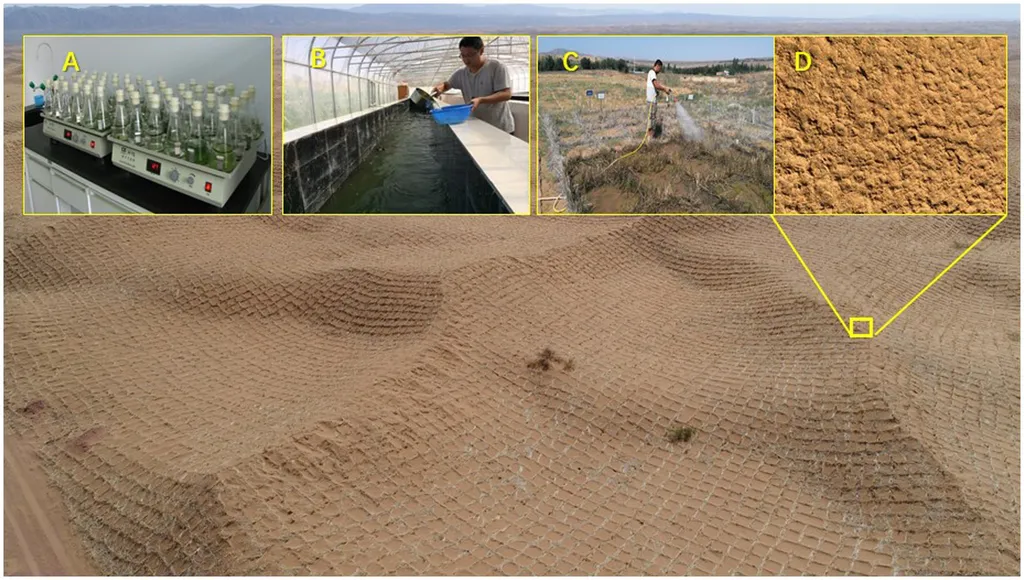
In the heart of China’s Shandong province, a groundbreaking study is reshaping our understanding of soil remediation in mining areas. Researchers led by Yuyang Li from the College of Forestry at Shandong Agricultural University have discovered that biological soil crusts (biocrusts) can significantly improve soil quality and plant growth in mining subsidence areas. The findings, published in *Frontiers in Plant Science*, offer promising avenues for sustainable agriculture and ecological restoration.
Biocrusts, composed of organisms like diatoms and bacteria such as Bacillus megaterium, play a crucial role in enhancing soil structure and regulating nutrients. The study compared the effects of different biocrust treatments—control, diatom, B. megaterium, and a combination of diatom-B. megaterium—on soil quality and plant growth in mining subsidence areas. The results were striking.
“Individual treatments with diatom biocrust and B. megaterium biocrust significantly enhanced organic carbon content, total nitrogen content, and invertase activity in the crust layer,” Li explained. This improvement led to a notable increase in the soil quality index, with values reaching 0.52 and 0.54, respectively. The diatom biocrust treatment also boosted ryegrass root biomass to 22.69 grams, a testament to its ability to improve soil structure through the secretion of extracellular polymeric substances.
However, the combination of diatom and B. megaterium biocrusts, while increasing crust roughness by 36.6% and soil moisture content by 18.7%, did not yield the expected synergistic effects on soil quality. Despite enhancing root biomass, the combined treatment did not improve the soil quality index as much as the individual treatments.
The implications for the agriculture sector are profound. Mining subsidence areas, often characterized by degraded soils, can be revitalized through the strategic application of biocrusts. This not only promotes sustainable land use but also opens up new opportunities for agricultural expansion and ecological restoration. The study provides a scientific basis for developing innovative soil remediation techniques that can be commercially applied in mining areas worldwide.
As the world grapples with the challenges of soil degradation and climate change, this research offers a beacon of hope. By harnessing the power of biocrusts, we can pave the way for a greener, more sustainable future. The findings underscore the importance of continued research and investment in agritech solutions that can transform degraded lands into productive ecosystems.
In the words of Li, “Our study highlights the potential of biocrusts in soil remediation and plant growth, providing a scientific foundation for the sustainable management and ecological restoration of degraded soils.” This research not only advances our understanding of soil ecology but also paves the way for practical applications that can benefit farmers, land managers, and the environment alike.