
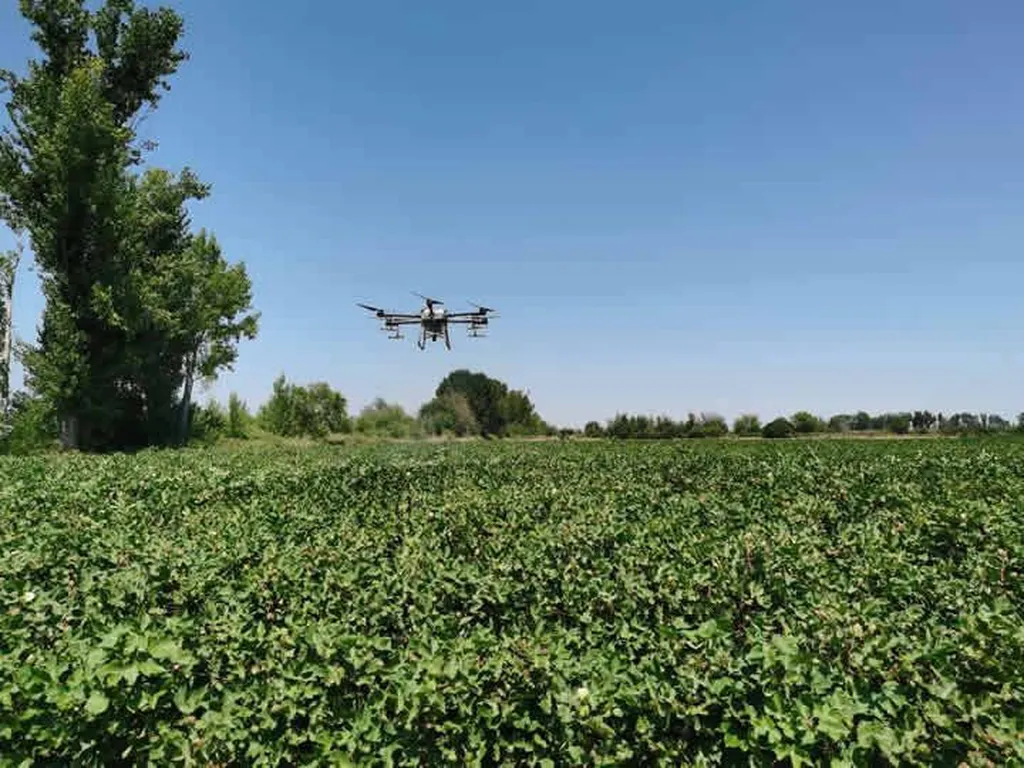
In the ever-evolving landscape of precision agriculture, researchers are continually seeking innovative methods to enhance crop monitoring and management. A recent study published in *Frontiers in Plant Science* has unveiled a promising approach that combines unmanned aerial vehicles (UAVs) and machine learning algorithms to estimate critical cotton plant traits, potentially revolutionizing the way farmers apply plant growth regulators (PGRs).
The research, led by Peter C. Ngimbwa from the College of Engineering at the University of Georgia, focuses on the height-to-node ratio and the fourth internode length in cotton plants. These traits are pivotal for determining the optimal timing of PGR applications, which are essential for maximizing yield and quality. Traditionally, these measurements have been labor-intensive and time-consuming, often requiring manual field assessments.
Ngimbwa and his team explored the use of vegetation indices (VIs) derived from UAV imagery, coupled with nonparametric, nonlinear machine learning algorithms, to estimate these traits more efficiently. “Our goal was to develop a robust, reliable method that could replace traditional field-based measurements,” Ngimbwa explained. “By leveraging UAV technology and machine learning, we aimed to provide farmers with more accurate and timely data to support their decision-making processes.”
The study involved data collection from eight experimental field plots, with six used for model training and two for testing. The researchers employed nested 5-fold cross-validation, repeated three times with different partitions, to assess model performance. Hyperparameters were tuned using Bayesian optimization with a Gaussian process surrogate, ensuring the models were finely calibrated.
The results were impressive. For predicting the height-to-node ratio, Support Vector Regression (SVR) emerged as the top performer, achieving an R² value of 0.8257. Meanwhile, the CatBoost algorithm excelled in estimating the fourth internode length, with an R² value of 0.799. These findings suggest that UAV-derived VIs, combined with machine learning, can consistently and accurately estimate these critical cotton traits.
The commercial implications of this research are significant. By automating the monitoring of these traits, farmers can make more informed decisions about PGR applications, potentially leading to improved crop yields and quality. “This approach not only saves time and labor but also enhances the precision of PGR management,” Ngimbwa noted. “It’s a win-win for both the farmers and the environment.”
The study also utilized the Shapley Additive exPlanations (SHAP) approach to reveal the contribution of each VI to the model’s predictions, adding a layer of interpretability to the machine learning process. This transparency is crucial for gaining the trust of farmers and agronomists, who may be skeptical of black-box machine learning models.
Looking ahead, this research could pave the way for broader applications of UAVs and machine learning in precision agriculture. As Ngimbwa envisions, “The integration of these technologies has the potential to transform the way we monitor and manage crops, not just for cotton but for a wide range of agricultural commodities.”
In conclusion, the study published in *Frontiers in Plant Science* by Peter C. Ngimbwa and his team represents a significant step forward in the field of precision agriculture. By harnessing the power of UAVs and machine learning, farmers can look forward to more efficient, accurate, and sustainable crop management practices. As the agriculture sector continues to embrace technological innovations, this research serves as a testament to the potential of data-driven approaches in shaping the future of farming.