
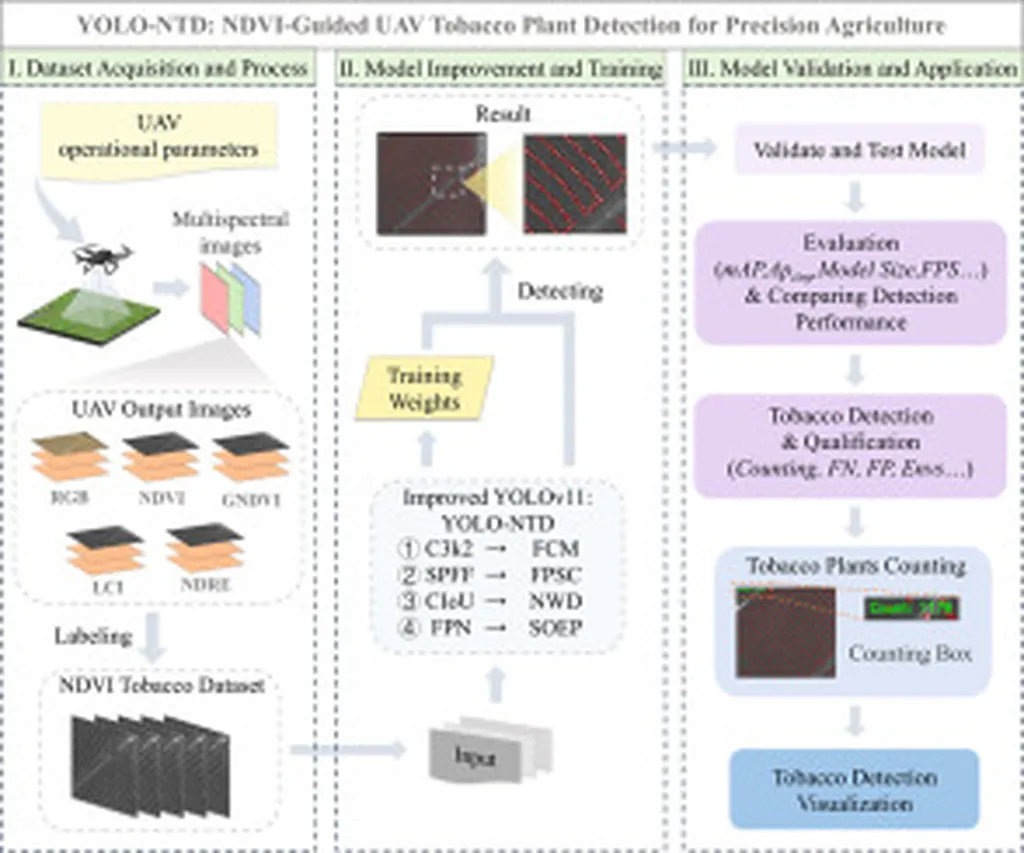
In the ever-evolving landscape of precision agriculture, a groundbreaking study published in *Smart Agricultural Technology* is set to revolutionize how farmers monitor and manage their crops. The research, led by Xinbao Chen from the School of Earth Sciences and Spatial Information Engineering at Hunan University of Sciences and Technology, introduces a novel framework that combines Unmanned Aerial Vehicles (UAVs) with deep learning to detect tobacco plants with unprecedented accuracy.
The challenge of early-stage crop detection has long plagued the agriculture sector. “Accurate and early detection of tobacco plants is essential for optimizing field management and ensuring stable yield,” Chen explains. However, the complexity of soil backgrounds and the small size of young plants have made reliable detection at the transplanting stage particularly difficult. This is where Chen’s innovative YOLO-NTD framework comes into play.
The YOLO-NTD model integrates the Normalized Difference Vegetation Index (NDVI) with deep learning to enhance the discrimination between crops and non-crops. The architecture is composed of three dedicated modules: the Small Object Enhanced Pyramid (SOEP) for capturing fine-grained features, the Feature Complementary Mapping (FCM) for enriching multi-scale contextual information, and the Fusion and Pyramid Spatial Channel (FPSC) for optimized feature fusion. Additionally, the Normalized Wasserstein Distance (NWD) metric is introduced to reduce localization sensitivity in small-object detection.
The results are impressive. YOLO-NTD achieves a mean Average Precision (mAP) of 69.9% at IoU thresholds ranging from 50% to 95%, and an APtiny of 54.6%, significantly outperforming baseline models while maintaining low computational overhead. “These findings confirm the efficacy of combining vegetation indices with deep learning for enhanced small-object detection,” Chen states.
The commercial implications for the agriculture sector are substantial. Precision agriculture relies heavily on accurate and timely data to optimize field management practices. With the ability to detect small, early-stage plants more reliably, farmers can make more informed decisions about irrigation, fertilization, and pest control. This not only improves crop yields but also reduces resource waste and environmental impact.
The integration of spectral indices with advanced detection models opens up new possibilities for UAV-based crop monitoring. As Chen notes, “This study provides a reliable and efficient solution for UAV-based crop monitoring, demonstrating that the integration of spectral indices with advanced detection models can substantially improve precision agriculture practices, particularly in early-stage crop management.”
Looking ahead, this research could shape future developments in the field by encouraging the adoption of similar technologies across different crops and agricultural practices. The success of YOLO-NTD highlights the potential of combining remote sensing with deep learning, paving the way for more sophisticated and efficient precision agriculture tools.
In an industry where every percentage point in yield can translate to significant economic gains, the ability to detect and manage crops more effectively is a game-changer. As the agriculture sector continues to embrace technological advancements, studies like Chen’s are at the forefront of driving innovation and sustainability.