
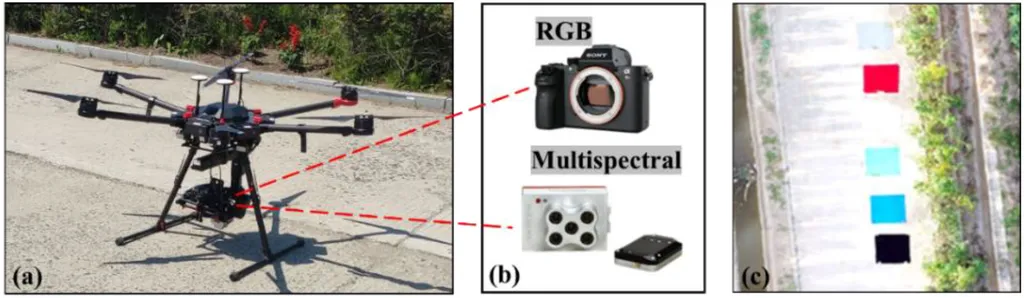
In the ever-evolving landscape of precision agriculture, researchers are continually seeking innovative methods to enhance crop yield and streamline breeding programs. A recent study published in *Revista Ceres* offers a promising advancement in this arena, demonstrating the potential of unmanned aerial vehicles (UAVs) equipped with RGB (red, green, and blue) cameras for early assessment of maize yield potential.
The research, led by Barbara Nascimento Santos, explores the use of high-throughput phenotyping techniques to identify high-yielding maize genotypes during the vegetative stage. This approach leverages the capabilities of UAVs to capture detailed aerial imagery, which is then processed to derive vegetation indices that correlate with grain yield.
“Our goal was to assess the effectiveness of RGB aerial imagery for early genotype selection,” Santos explains. “By doing so, we aimed to enhance the efficiency of breeding programs and contribute to the broader goals of precision agriculture.”
The study involved evaluating four maize genotypes using a randomized block design with four replications. Seven flights were conducted at two different heights to capture a comprehensive dataset. From this imagery, 29 RGB vegetation indices were derived, with the aim of discriminating genotypes based on plot-level grain yield.
The findings revealed significant differences among genotypes and plant spacing, highlighting the potential of RGB imagery for early phenotype selection. The optimal flight timing was identified as 43 days after planting at a height of 80 meters. Notably, the indices MRCC, RmB, and RCC exhibited the highest repeatability and showed strong correlations with grain yield.
“This research underscores the utility of RGB imagery as a tool for early maize genotype selection,” Santos notes. “By enhancing the efficiency and accuracy of breeding programs, we can contribute to advancements in precision agriculture and ultimately improve crop yields.”
The commercial implications of this research are substantial. By enabling early identification of high-yielding genotypes, farmers and breeders can make more informed decisions, optimizing resource allocation and improving overall productivity. This technology could also facilitate the development of more resilient and high-yielding maize varieties, addressing the growing demand for food security in a changing climate.
As the agriculture sector continues to embrace technological innovations, the integration of UAVs and high-throughput phenotyping techniques is poised to play a pivotal role. The research led by Barbara Nascimento Santos, published in *Revista Ceres*, offers a glimpse into the future of precision agriculture, where data-driven decisions and advanced imaging technologies converge to revolutionize crop breeding and management.
This study not only highlights the potential of RGB imagery for early genotype selection but also sets the stage for further advancements in the field. As researchers continue to explore the capabilities of UAVs and other cutting-edge technologies, the agriculture sector can look forward to a future of enhanced productivity, sustainability, and innovation.