
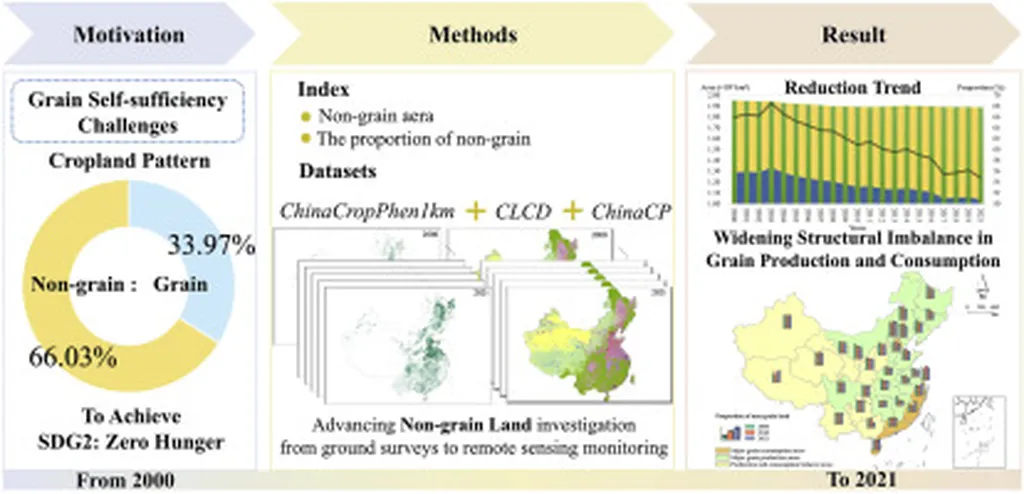
In the heart of China’s karst landscape, a pressing challenge unfolds: the expansion of non-grain cultivated land. This shift, while offering economic opportunities, poses significant threats to sustainable land use, particularly in ecologically fragile regions like Guizhou Province. A recent study published in *Frontiers in Sustainable Food Systems* sheds light on the spatial patterns and driving forces behind this trend, offering crucial insights for policymakers and agricultural stakeholders.
Guizhou Province, known for its extensive karst landforms, serves as the backdrop for this investigation. The study, led by Nanjia Cai from the School of Karst Science at Guizhou Normal University, categorizes non-grain cultivated land into four types: planted non-grain crops (PNGC), unplanted cultivated land (UCL), engineering recoverable (ENR), and immediately recoverable (IMR). This classification is based on the difficulty of restoration and cropping attributes, providing a nuanced understanding of the land use dynamics.
The findings reveal that non-grain cultivated land accounts for 27.78% of the total cultivated land in Guizhou, with engineering recoverable land covering the largest area. Notably, the conversion of cultivated land to forest and orchard land is significant, reflecting a shift in agricultural practices. “The spatial distribution and clustering patterns of each type of non-grain cultivated land are strongly correlated,” explains Cai. “Hotspots are concentrated in the central and northeastern regions, while cold spots are found in the southeast.”
The study employs spatial autocorrelation, hotspot analysis, and the geographic detector method to explore the driving factors behind these patterns. Among multiple influences, the distance to residential areas emerges as the primary factor shaping the spatial distribution of non-grain cultivated land. However, each type of land has its own dominant drivers, with some internal correlations existing between them.
The commercial impacts of these findings are profound. For the agriculture sector, understanding the spatial patterns and driving forces of non-grain cultivated land can inform strategic planning and investment. Farmers and agribusinesses can leverage this knowledge to optimize land use, enhance productivity, and mitigate environmental risks. Policymakers, too, can use these insights to develop targeted regulatory measures that promote sustainable agriculture and land use practices.
As the global demand for diverse agricultural products continues to grow, the insights from this study become increasingly relevant. The shift towards non-grain production offers economic opportunities but also necessitates careful management to ensure ecological sustainability. By providing differentiated regional references and policy implications, this research paves the way for more informed decision-making in the agriculture sector.
In the words of Nanjia Cai, “This study offers a comprehensive understanding of the spatial patterns and driving mechanisms of non-grain cultivated land in karst plateau mountainous areas. It provides a foundation for developing strategies that balance economic growth with environmental conservation.” As the agriculture sector navigates the complexities of land use in fragile ecosystems, such research becomes an invaluable guide for shaping a sustainable future.