
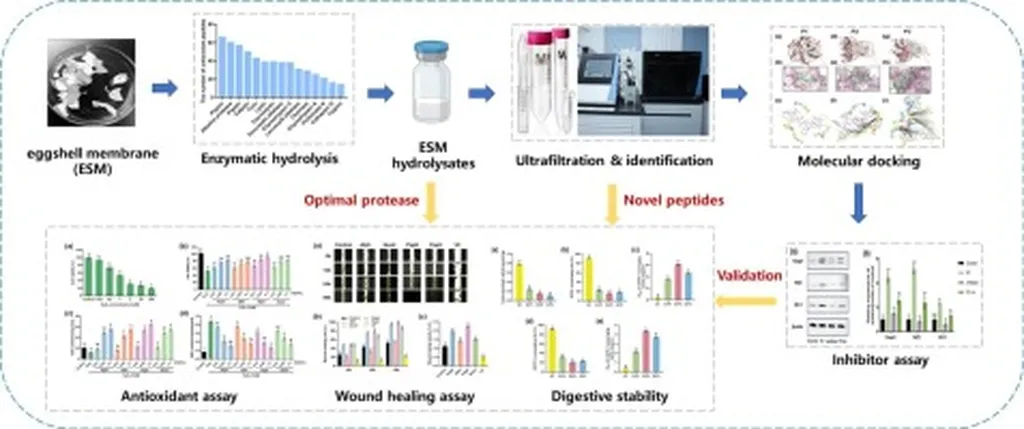
In a groundbreaking study published in the *Journal of Functional Foods*, researchers have uncovered the wound-healing potential of novel peptides derived from eggshell membranes (ESM), offering a promising avenue for the high-value utilization of a typically discarded agricultural byproduct. The research, led by Yanan Gao from the Key Laboratory of Agro-Products Quality and Safety Control in Storage and Transport Process of Ministry of Agriculture and Rural Affairs, Chinese Academy of Agricultural Sciences, highlights the antioxidant and wound-healing properties of these peptides, paving the way for innovative applications in the agricultural and biomedical sectors.
The study focused on the hydrolysates prepared from eggshell membranes using papain, an enzyme known for its ability to break down proteins. Among the various hydrolysates tested, those prepared by papain (PapH) exhibited the highest antioxidant and wound-healing activity. Through a combination of in silico (computational) and in vitro (laboratory) approaches, the researchers identified three novel peptides: KDFPCPM (P1), DKDGPFRLC (P2), and LVEKGDVAF (P3). These peptides were subsequently synthesized and tested for their biological activities.
The results were striking. All three synthetic peptides displayed excellent antioxidant and wound-healing effects, with P1 surpassing the others in efficacy. Molecular docking studies revealed that P1 could form stable bonds with Keap1, a key protein involved in the regulation of the Nrf2/HO-1 signaling pathway, which plays a crucial role in cellular antioxidant defense mechanisms.
“Our findings suggest that the peptides derived from eggshell membranes have significant potential for enhancing wound healing and antioxidant activity,” said lead author Yanan Gao. “This research not only provides new insights into the high-value utilization of discarded eggshell membranes but also opens up new possibilities for the development of bioactive peptides in the agricultural and biomedical fields.”
The implications of this research are far-reaching. Eggshell membranes, which are typically discarded as waste in the poultry industry, could be transformed into valuable bioactive compounds. This not only reduces waste but also creates new revenue streams for farmers and agricultural businesses. The peptides identified in this study could be incorporated into wound healing products, dietary supplements, or even functional foods, offering a sustainable and cost-effective solution for enhancing human health.
Moreover, the integration of in silico and in vitro approaches in this study sets a precedent for future research. By combining computational modeling with laboratory experiments, researchers can more efficiently identify and characterize bioactive compounds, accelerating the development of new agricultural and biomedical technologies.
As the global demand for sustainable and high-value agricultural products continues to grow, this research highlights the importance of exploring the potential of agricultural byproducts. The discovery of bioactive peptides from eggshell membranes is just the beginning. Future studies could focus on optimizing the extraction and purification processes, as well as exploring the potential applications of these peptides in other areas, such as animal health and nutrition.
In conclusion, this study not only advances our understanding of the bioactive properties of eggshell membranes but also underscores the importance of interdisciplinary research in driving innovation in the agricultural sector. By harnessing the power of computational and experimental approaches, researchers can unlock the full potential of agricultural byproducts, creating new opportunities for sustainable and profitable agricultural practices.