
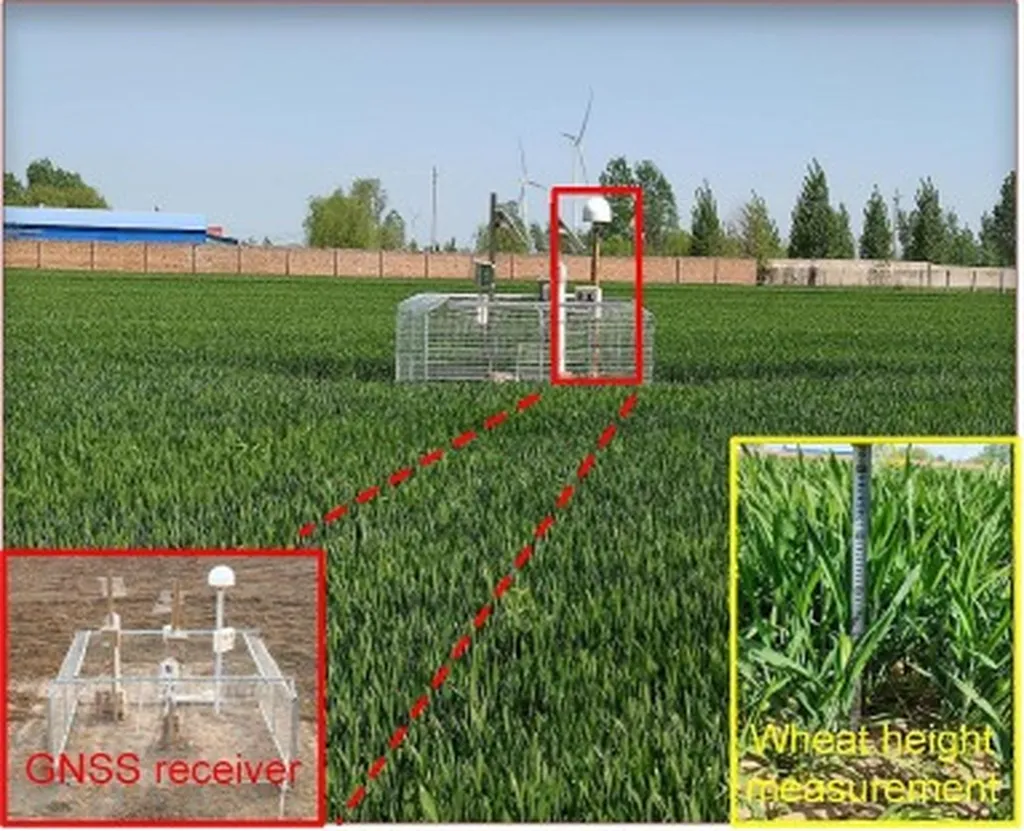
In a groundbreaking development for precision agriculture, researchers have successfully demonstrated a novel method for monitoring wheat growth using reflected GPS and BDS signals. This approach, detailed in a study published in *Frontiers in Plant Science*, leverages pseudorange and dual-frequency carrier phase observables, offering a promising alternative to traditional signal-to-noise ratio (SNR) techniques.
The study, led by Mingming Sui from the College of Civil Engineering at Nanjing Forestry University, presents the first successful attempt to retrieve wheat height using ground-based Global Navigation Satellite System Reflectometry (GNSS-R). The research addresses a critical limitation in conventional GNSS-R methods, which rely on SNR observables and are often constrained by data availability and the effectiveness of observable combination methods.
“Our study introduces a robust and scalable tool for continuous crop growth tracking,” Sui explained. “By utilizing pseudorange and dual-frequency carrier phase observables, we can overcome the limitations of SNR-based methods, providing more reliable and accessible data for farmers and agritech companies.”
The field experiment, conducted at the Fengqiu Agro-ecology Experimental Station in China, evaluated six observable combination schemes from GPS and BDS. The researchers employed a multi-system, multi-satellite fusion strategy, incorporating principal frequency power weighting within each system and residual reciprocal weighting across systems. This approach effectively captured wheat growth dynamics, with the best-performing combinations achieving high correlation coefficients and low root mean square error (RMSE) values.
The findings highlight the feasibility and superiority of pseudorange and dual-frequency carrier phase combinations for SNR-independent GNSS-R crop monitoring. “This method offers a significant advancement in precision agriculture,” Sui noted. “It provides a continuous and high-resolution technique for monitoring crop growth, which is crucial for optimizing yields and resource management.”
The commercial implications of this research are substantial. By offering a low-cost, continuous, and high-resolution technique for monitoring crop growth, this method can enhance decision-making processes for farmers and agritech companies. The ability to track crop growth dynamics accurately can lead to improved resource allocation, better pest and disease management, and ultimately, increased agricultural productivity.
Moreover, the proposed strategy is particularly valuable in contexts where SNR data are unavailable or unreliable. This makes it a versatile tool for various agricultural settings, from small-scale farms to large-scale commercial operations.
The study’s findings pave the way for future developments in the field of precision agriculture. As the technology becomes more widely adopted, it has the potential to revolutionize how crops are monitored and managed, contributing to more sustainable and efficient agricultural practices.
In summary, this research represents a significant step forward in the application of GNSS-R technology for crop monitoring. By leveraging pseudorange and dual-frequency carrier phase observables, the study offers a robust and scalable solution that can enhance the precision and efficiency of agricultural practices worldwide.