
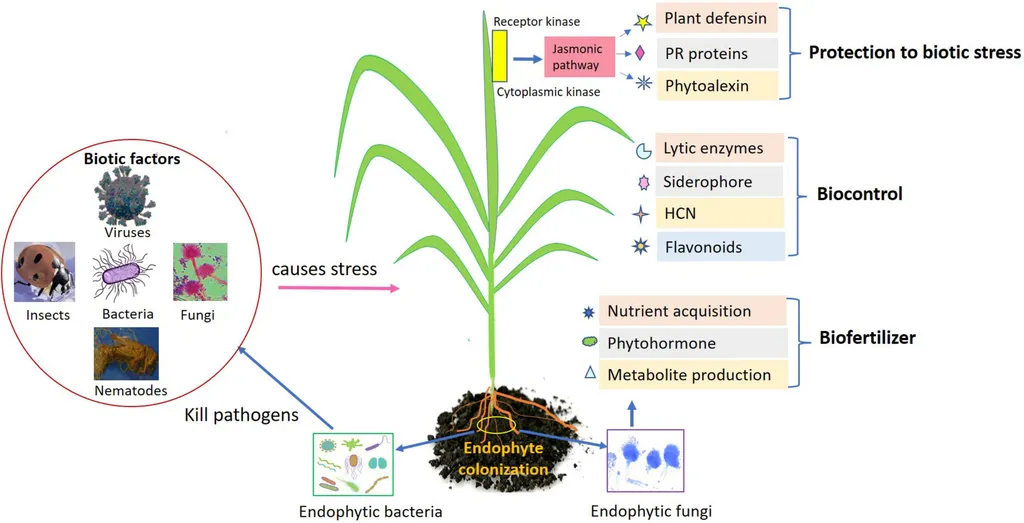
In the quest for sustainable agriculture, scientists are turning to nature’s own defenses to combat plant pathogens. A recent study published in *Frontiers in Microbiology* has uncovered promising results in the use of endophytic bacteria to inhibit the growth of *Fusarium graminearum*, a notorious pathogen that causes significant crop losses worldwide. The research, led by Ying-ping Hu from the National Engineering Research Center of JUNCAO Technology at Fujian Agriculture and Forestry University, highlights the potential of these bacteria as a novel biocontrol agent.
Endophytic bacteria, which live within plant tissues without causing harm, have long been recognized for their ability to protect plants from pathogens. This study focused on screening and characterizing endophytic bacteria from upland rice, specifically targeting their antagonistic activity against *F. graminearum*. The researchers identified two bacterial strains, URR1 and URR2, which were found to be *Pseudomonas sp.* and *Bacillus subtilis*, respectively. Both strains demonstrated strong inhibitory activity against the pathogen, with inhibition rates of 69.73% and 76.33%, respectively.
The study’s findings are particularly significant for the agriculture sector, as *F. graminearum* is responsible for diseases such as Fusarium head blight in wheat and bakanae disease in rice, which can lead to substantial yield losses. “The potential of these endophytic bacteria to act as biocontrol agents could revolutionize how we manage plant pathogens,” said Hu. “This could lead to more sustainable and environmentally friendly agricultural practices.”
The researchers conducted a series of experiments to evaluate the antagonistic potential of the bacterial strains. Dual-culture antagonism assays showed that both strains significantly alleviated stress in upland rice seedlings infected with *F. graminearum* after just seven days. Furthermore, the study identified specific antifungal compounds produced by the bacteria, including lipopeptides and volatile organic compounds (VOCs), which played a crucial role in inhibiting the pathogen’s growth.
The lipopeptides, comprising 10 distinct surfactin isoforms and 7 fengycin variants, were found to be particularly effective. The maximum inhibition rate of crude lipopeptides reached 63.86% after 96 hours of treatment. VOCs such as acetone, ethanol, trichloromethane, pyruvic acid, and propadiene also showed significant inhibitory effects, with a peak hyphal inhibition rate of 30.38% after 48 hours of exposure.
Metabolomic analysis revealed that the differentially upregulated metabolites encompassed a wide range of classes, including organic acids, lipids, and organoheterocyclic compounds. These metabolites were significantly concentrated in multiple metabolic pathways, indicating the multifaceted antagonistic mechanism of *B. subtilis* against *F. graminearum*.
The commercial implications of this research are substantial. As the agriculture sector seeks to reduce its reliance on chemical pesticides, the development of biocontrol agents offers a sustainable alternative. “The use of endophytic bacteria as biocontrol agents could not only improve crop yields but also contribute to the overall health of the environment,” said Hu. “This is a significant step towards more sustainable and resilient agricultural systems.”
The study’s findings open up new avenues for research and development in the field of agricultural biotechnology. Future studies could focus on optimizing the application of these bacterial strains in different crop systems and exploring their potential in combination with other biocontrol agents. Additionally, further research could delve into the genetic and molecular mechanisms underlying the antagonistic activity of these endophytic bacteria, paving the way for the development of more targeted and effective biocontrol strategies.
In conclusion, this research represents a significant advancement in the quest for sustainable agriculture. By harnessing the power of endophytic bacteria, we can develop innovative solutions to combat plant pathogens and ensure food security for future generations. The study, published in *Frontiers in Microbiology* and led by Ying-ping Hu from the National Engineering Research Center of JUNCAO Technology at Fujian Agriculture and Forestry University, underscores the potential of these microorganisms to revolutionize agricultural practices and contribute to a more sustainable future.