
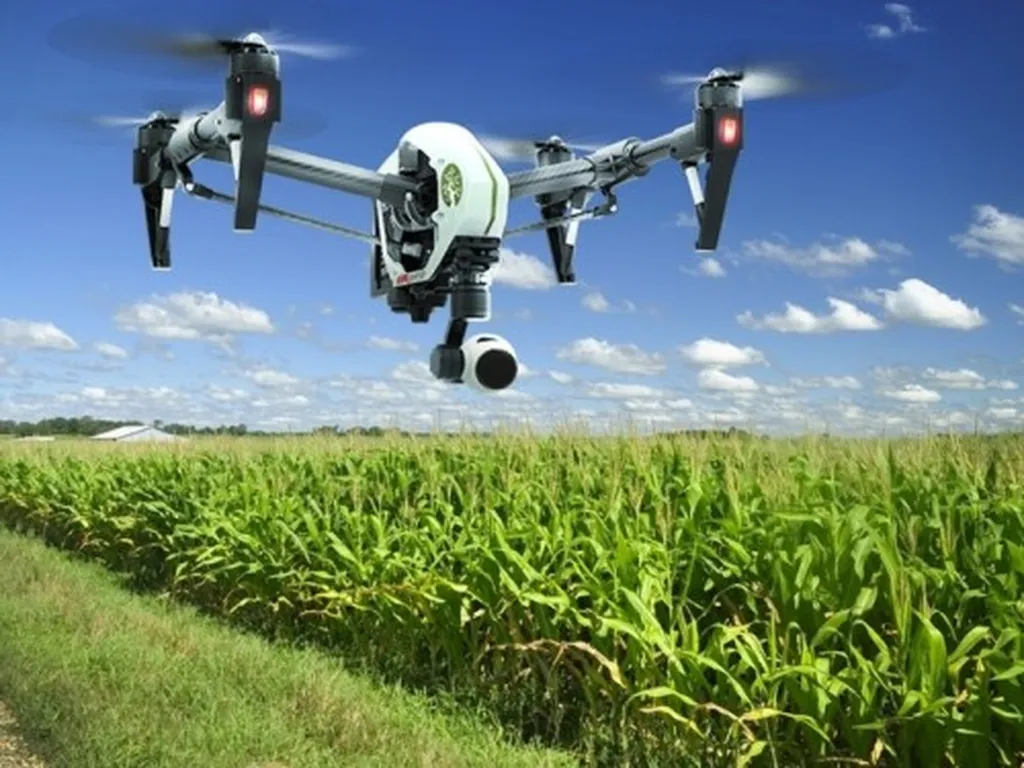
In the rapidly evolving world of precision agriculture, early and accurate detection of crop diseases is paramount. A recent study published in *Frontiers in Plant Science* introduces a groundbreaking model that could revolutionize how farmers monitor and manage crop health using unmanned aerial vehicles (UAVs). The research, led by Ting Zhang, proposes a novel Multiscale CNN-State Space Model with Feature Fusion (MSCNN-VSS), designed to tackle the complexities of detecting crop diseases from aerial imagery.
Crop diseases pose a significant challenge to global agriculture, often leading to substantial yield losses if not detected and treated promptly. Traditional methods of disease detection rely heavily on manual inspection, which is time-consuming and prone to human error. UAVs equipped with advanced imaging technology offer a more efficient and scalable solution, but the analysis of high-resolution aerial images presents its own set of challenges. “The complexity of backgrounds, variable scales of lesions, and the need to model both fine-grained spot details and long-range spatial dependencies within large field scenes make this task particularly demanding,” explains Zhang.
The MSCNN-VSS model addresses these challenges through a multi-level feature extraction and integration approach. At its core, the model employs a dilated multi-scale Inception module to capture diverse local lesion patterns across different scales without compromising spatial detail. This is complemented by a Visual State Space (VSS) block, which efficiently models global contextual relationships across the canopy with linear computational complexity. “The VSS block overcomes the limitations of Transformers on high-resolution UAV images, providing a more efficient and effective solution,” says Zhang.
The model also incorporates a hybrid attention module to refine the fused features and accentuate subtle diseased regions. Extensive experiments on a UAV-based crop disease dataset demonstrate that MSCNN-VSS achieves state-of-the-art performance, with a Pixel Accuracy (PA) of 0.9421 and a mean Intersection over Union (mIoU) of 0.9152. These results significantly outperform existing CNN and Transformer-based benchmarks, highlighting the model’s potential for practical agricultural applications.
The commercial implications of this research are substantial. By enabling more accurate and timely detection of crop diseases, farmers can implement targeted treatments, reducing the need for broad-spectrum pesticides and minimizing environmental impact. This precision approach not only improves crop yields but also enhances sustainability in agriculture. “The ability to detect diseases early and with high accuracy can lead to significant cost savings and improved crop health, ultimately benefiting both farmers and consumers,” Zhang notes.
The MSCNN-VSS model represents a significant advancement in the field of crop disease detection. Its innovative design and superior performance suggest that it could become a standard tool in precision agriculture. As UAV technology continues to evolve, models like MSCNN-VSS will play a crucial role in shaping the future of agricultural monitoring and management. This research not only provides a robust solution for current challenges but also paves the way for further developments in the field, potentially integrating with other emerging technologies such as artificial intelligence and machine learning to create even more sophisticated agricultural systems.
While the lead author’s affiliation is not specified, the impact of this research is clear. As the agriculture sector continues to embrace technological innovations, the MSCNN-VSS model stands out as a promising tool for enhancing crop disease detection and management, ultimately contributing to a more sustainable and productive future for agriculture.