
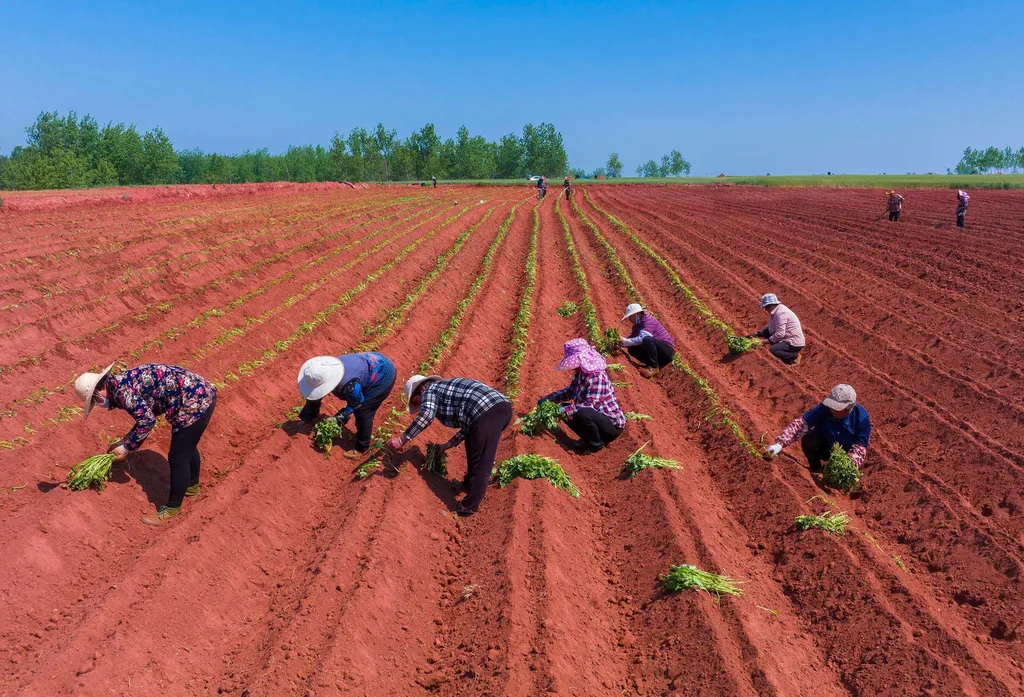
In the heart of China’s vast croplands, a silent transformation has been unfolding beneath our feet over the past four decades. A recent study published in *Advanced Science* has uncovered significant changes in the fundamental balance of elements in the soil, a shift that could have profound implications for agriculture and ecosystem services.
The research, led by Xiaodong Sun of the Institute of Environment and Sustainable Development in Agriculture at the Chinese Academy of Agricultural Sciences, delved into the soil carbon (C), nitrogen (N), and phosphorus (P) stoichiometry—essentially the balance and interplay of these critical elements—across a 0–100 cm soil profile. By analyzing repeated measurements from 305 resampling sites taken between the 1980s and 2023, totaling 6405 soil profiles, the study offers a comprehensive look at how climate change and nutrient inputs have reshaped the soil’s elemental composition.
The findings are striking. Over the past four decades, the mean soil C:N ratio across the entire profile increased by 20.18%, while the C:P ratio rose by 4.49%. However, the N:P ratio decreased by 9.02%. These changes are not uniform across the landscape or the soil profile. Spatially, the changes in C:N and N:P ratios tend to weaken with increasing latitude. More intriguingly, the changes exhibit clear depth-dependent patterns. The soil C:N ratios increased across the entire soil profile, while the C:P and N:P ratios increased in the topsoil (0–40 cm) but decreased in the subsoil (40–100 cm).
“These depth-dependent changes are primarily driven by organic carbon and nutrient inputs, influenced by initial soil conditions and climate,” explains Sun. This nuanced understanding of soil stoichiometry could revolutionize how farmers and agronomists approach soil management, potentially leading to more sustainable and productive agricultural practices.
The commercial impacts of this research are substantial. For the agriculture sector, understanding these changes can inform better nutrient management strategies, optimizing fertilizer use, and enhancing soil health. This could lead to increased crop yields and reduced environmental impacts, such as nutrient runoff and greenhouse gas emissions. As the global population grows and climate change intensifies, the need for sustainable agricultural practices becomes ever more critical.
Moreover, the study highlights the importance of long-term data collection and analysis. The depth-dependent changes observed in this research underscore the complexity of soil ecosystems and the need for tailored management practices. “Our findings suggest that a one-size-fits-all approach to soil management may not be effective,” Sun notes. “Instead, strategies should be adapted to specific soil profiles and regional conditions.”
Looking ahead, this research could shape future developments in agroecosystems and soil science. By understanding how soil stoichiometry responds to long-term management practices and environmental changes, scientists and farmers can work together to develop more resilient and productive agricultural systems. The study also calls for further research to explore the underlying mechanisms driving these changes and to develop practical applications for farmers.
In the ever-evolving landscape of agriculture, this study serves as a reminder of the intricate and dynamic nature of our soils. As we strive to feed a growing population in a changing climate, the insights gained from this research could be a game-changer, paving the way for more sustainable and productive farming practices.