
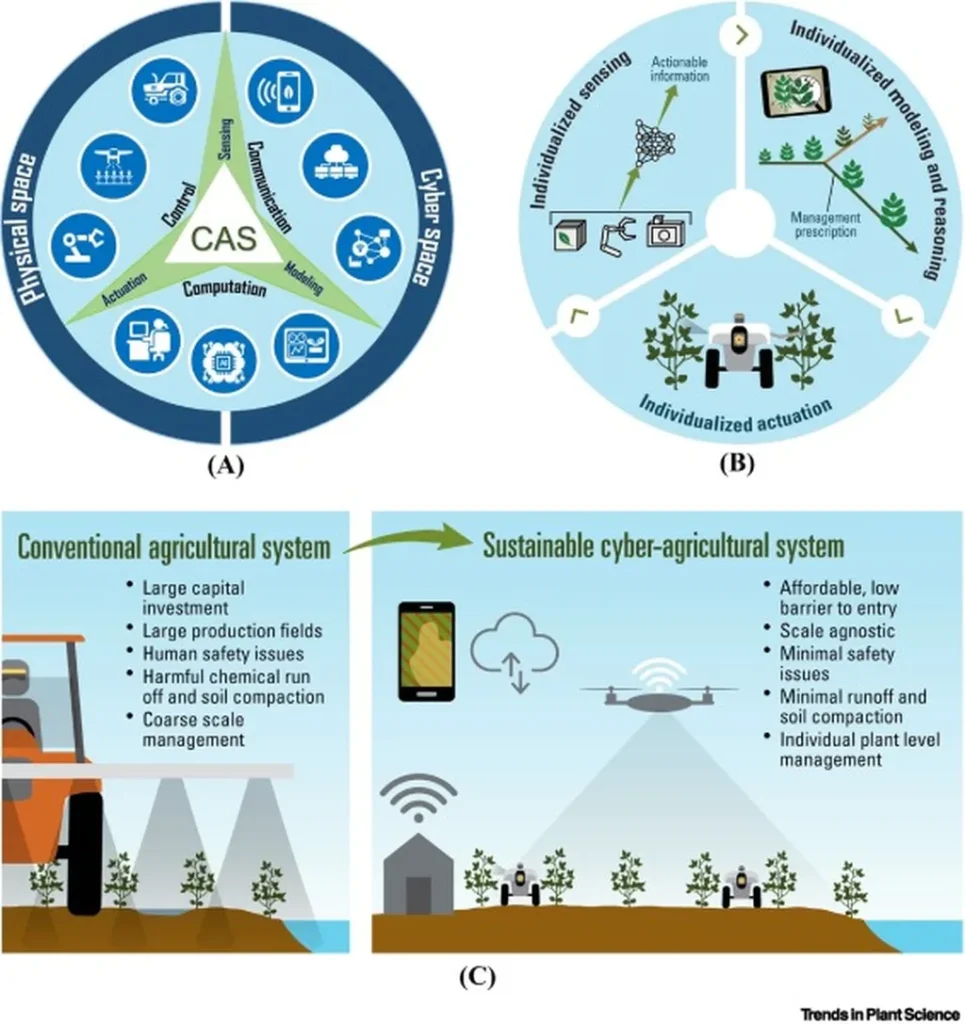
In the ever-evolving landscape of agricultural technology, a groundbreaking study has emerged that could revolutionize the way farmers maintain their machinery. Published in *Research in Agricultural Engineering*, the research introduces a cyber-physical system designed to automate the washing of agricultural machinery, promising enhanced efficiency and intelligent control. This innovation could significantly impact the agriculture sector by reducing downtime and improving operational efficiency.
The system, developed by Anatoliy Tryhuba from the Department of Information Technology at Lviv National Environmental University in Ukraine, is structured into four layers: physical, sensor, computational, and interface. This architecture integrates actuators, sensors, decision-making modules, and analytics to create a seamless and automated washing process. The system’s design is not just about cleaning machinery; it’s about optimizing the entire process through intelligent control.
To validate their design, the researchers conducted a Python-based simulation using Control and SimPy. The results were impressive, with an average washing time of 10.4 minutes and a 97.5% cycle initiation accuracy under critical contamination. The control mechanisms employed included gated recurrent unit (GRU) prediction and proportional-integral-derivative (PID) regulation, which ensured precise and efficient operation.
“This system is not just about automating a mundane task; it’s about integrating intelligent control to enhance the overall efficiency of agricultural operations,” said Tryhuba. The implications for the agriculture sector are vast. By automating the washing process, farmers can reduce the time and labor required for maintenance, allowing them to focus on other critical aspects of their operations. This could lead to increased productivity and profitability, as well as improved sustainability through more efficient use of resources.
The research also highlights the potential for future developments, such as real-world validation and the creation of digital twins. Digital twins, which are virtual replicas of physical systems, could further enhance the system’s capabilities by providing real-time monitoring and predictive maintenance. This could be a game-changer for the agriculture sector, enabling farmers to anticipate and address issues before they become critical.
While the study assumes ideal sensors and fixed conditions, the feasibility of the system has been proven. The next steps involve validating the system in real-world scenarios and developing digital twins to further enhance its capabilities. This research not only paves the way for more efficient agricultural practices but also sets the stage for future innovations in the field of agritech.
As the agriculture sector continues to evolve, the integration of intelligent mechatronic architectures and automation will play a crucial role in shaping its future. This research is a testament to the potential of these technologies and their ability to transform the way we approach agricultural maintenance and operations.